
Invoice Meaning: What an Invoice Is and What It Must Include
Contents
- What is an invoice?
- Invoice meaning in business and accounting
- What an invoice includes
- A worked example, start to finish
- Invoice vs receipt, quote, estimate and bill
- Common types of invoices
- When and how to send an invoice
- Invoice in Spanish, French and other languages
- Mistakes that delay payment
- Make your first invoice
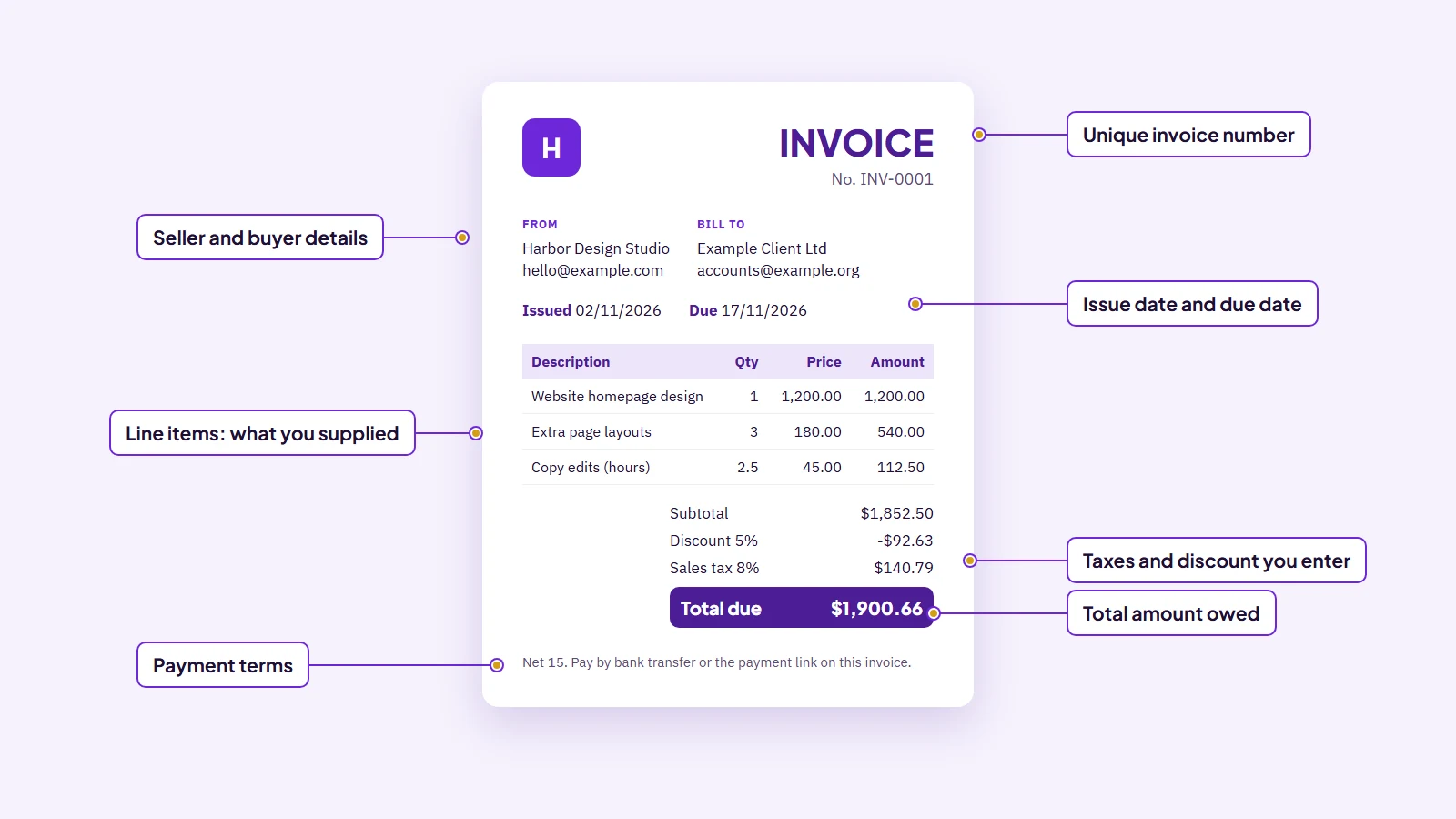
The invoice meaning is simple: an invoice is a document a seller sends to a buyer that lists the goods or services supplied, states what they cost, and asks for payment by a certain date. It is the written request that turns finished work into money owed, and it becomes a record for both sides once it is paid.
That one sentence covers most of the invoice meaning people want when they search "what is an invoice". The rest of this guide explains what an invoice has to contain, how it differs from a receipt, a quote and a bill, which types you will run into, and how the numbers on a real invoice are worked out. We build invoicing software, so we will also point out the small details that decide whether you get paid on time.
What is an invoice?
Put simply, the invoice meaning comes down to a payment request with evidence attached. The Cambridge Dictionary defines it as "a document that lists things provided or work done, gives their cost, and asks for payment." Every useful invoice does those three jobs: it lists, it prices, and it asks.
A practical invoice definition adds two things the dictionary leaves out. First, an invoice is addressed to a specific customer, so it names both parties. Second, it carries a date and a deadline, because a request for payment without a due date is easy to ignore.
So, what is an invoice used for? In day-to-day business it does four jobs at once:
- It asks for payment. The client knows the exact amount and the date it is due.
- It documents the sale. Both sides can see what was delivered and at what price.
- It feeds the books. The seller records income it is owed; the buyer records a bill it has to pay.
- It supports taxes and audits. Tax authorities treat invoices as supporting records, as we cover below.
Our view after building an invoice generator: most "invoice problems" are really clarity problems. An invoice that answers who, what, how much and by when in five seconds gets paid faster than a beautiful one that hides the due date.
Invoice meaning in business and accounting
In business, the invoice meaning shifts slightly depending on which side of the sale you are on. For the seller, it is a sales invoice (sometimes called a customer invoice). For the buyer, the very same document is a vendor invoice or supplier invoice, a bill that needs to be approved and paid.
What is an invoice in accounting?
In accounting, an issued invoice is the trigger for recording revenue that has been earned but not yet collected. Until the client pays, that amount sits in accounts receivable (money customers owe you). On the buyer's side the matching entry sits in accounts payable (money you owe suppliers). When the payment arrives, the invoice is marked paid and the receivable is cleared. That is the invoice meaning in accounting: a dated claim for money that moves from owed to paid.
This is why accountants care so much about invoice numbers. A unique number lets you match each payment to exactly one invoice, spot gaps, and find a document quickly when someone asks. If you use a gap-free sequence such as INV-0001, INV-0002 and so on, missing or duplicated invoices stand out at a glance.
Invoices also matter as evidence. The US Internal Revenue Service lists invoices among the supporting documents a business should keep: "Supporting documents include sales slips, paid bills, invoices, receipts, deposit slips, and canceled checks." The IRS also notes on its recordkeeping page that "Except in a few cases, the law does not require any special kind of records." In other words, the format is flexible, but the record itself needs to exist. Rules differ by country, so check what your own tax authority expects.
Key takeaway: one document, two names. Your sales invoice is your client's vendor invoice. Writing it so their accounts team can approve it without emailing you back is the fastest route to payment.
What an invoice includes
There is no single worldwide template, but the core contents are remarkably consistent. The UK government guidance on what an invoice must include is a good, plain checklist. For UK businesses it lists:
- a unique identification number
- your company name, address and contact information
- the company name and address of the customer you are invoicing
- a clear description of what you are charging for
- the date the goods or service were provided (supply date)
- the date of the invoice
- the amount(s) being charged
- VAT amount if applicable
- the total amount owed
The same GOV.UK page adds that "You must use VAT invoices if you and your customer are VAT registered," which comes with extra fields. Other countries have their own tax invoice rules, so treat this list as the minimum and check your local requirements before you rely on it for tax purposes.
Here is how those fields work in practice, plus the optional extras that make an invoice easier to pay:
| Field | Why it matters | Required or helpful |
|---|---|---|
| Invoice number | Matches each payment to one document | Required in most places |
| Your details and the client's | Shows who is billing whom | Required |
| Issue date and supply date | Fixes when the sale happened | Required in the UK |
| Line items | Describes what you delivered, with quantity and price | Required |
| Tax and discount | Shows how the total was reached | Required when tax applies |
| Total and due date | Tells the client exactly what to pay and when | Total required; due date strongly advised |
| Payment details or link | Removes the "how do I pay you?" email | Helpful |
| Purchase order number | Lets larger clients route the invoice for approval | Helpful, sometimes required by the client |
Payment terms like net 30
Payment terms tell the client how long they have. "Due on receipt" means now. "Net 30" is, in the words of the Cambridge Business English Dictionary, "written on an invoice to show that it must be paid within 30 days." We recommend printing the actual calendar date next to the term. "Net 15" makes the client count; "Due 17/11/2026" does not.
A worked example, start to finish
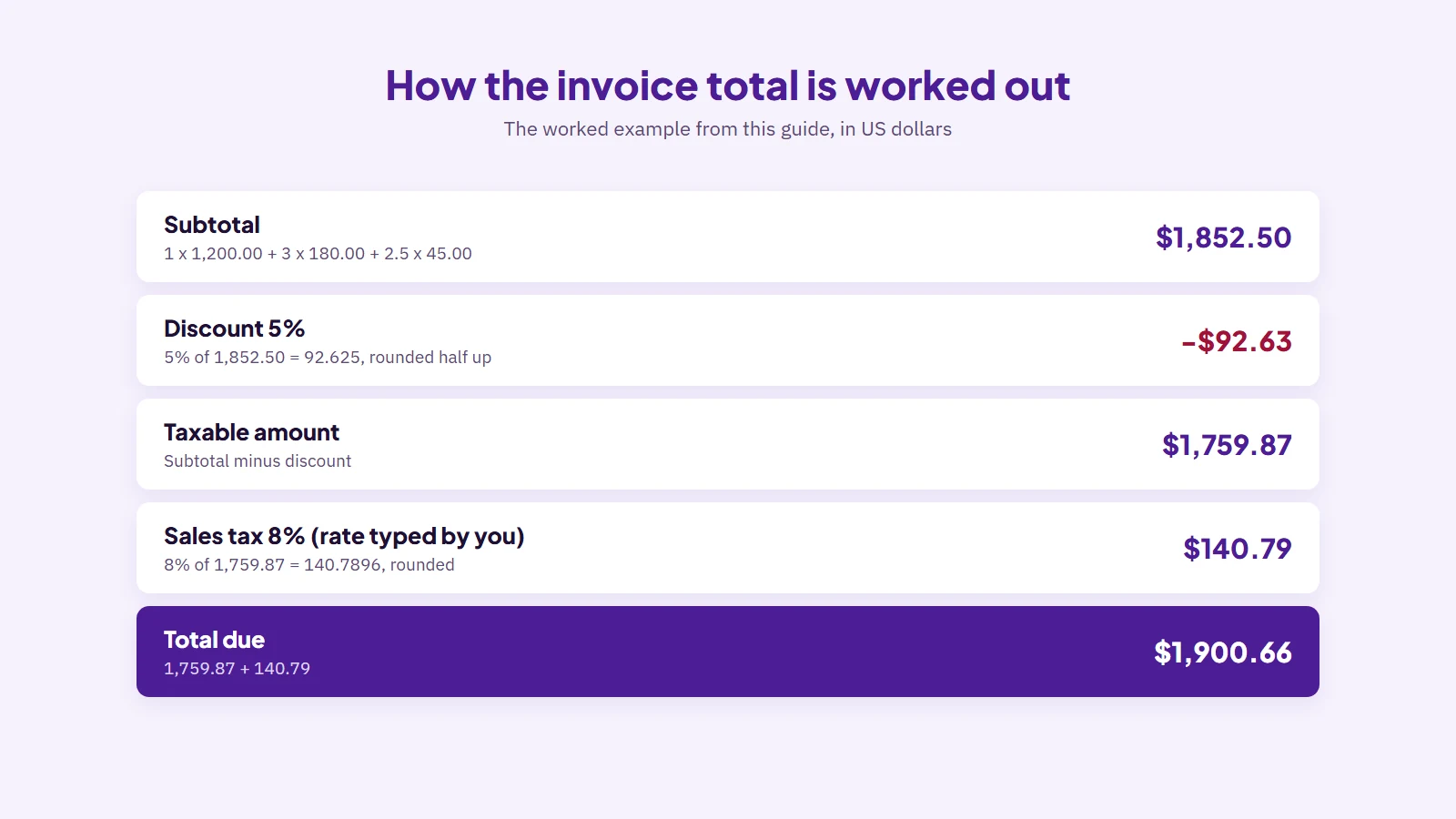
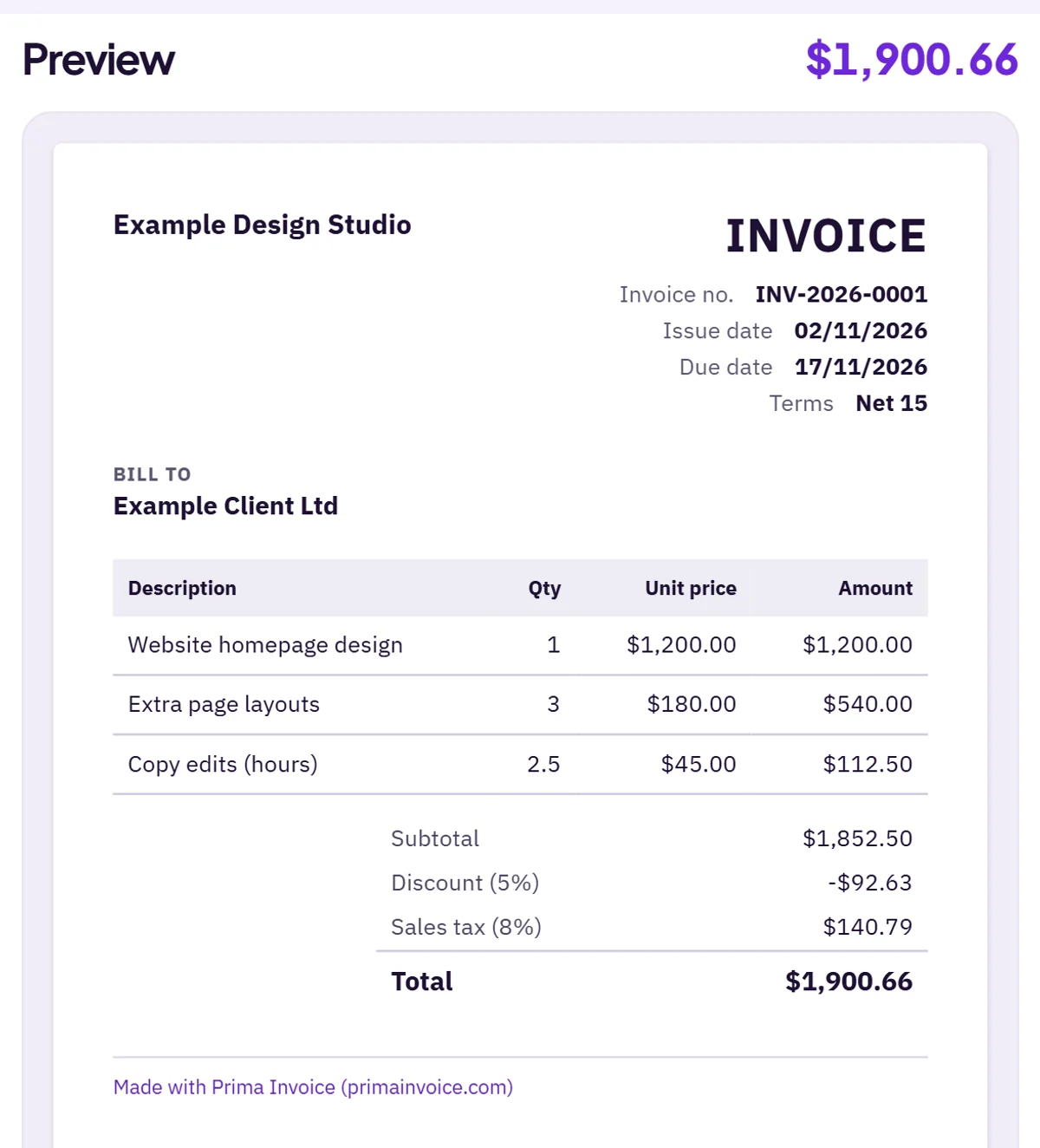
The invoice meaning is easier to grasp with real numbers, so here is an invoice built for this guide. A small design studio bills a client in US dollars for three line items, gives a 5% discount and adds sales tax at 8%. The tax rate is an example; you type the rate that applies to you. We ran these numbers through the same calculation code that powers the Prima Invoice generator, so the totals below are exactly what the tool produces.
| Description | Qty | Unit price | Amount |
|---|---|---|---|
| Website homepage design | 1 | 1,200.00 | 1,200.00 |
| Extra page layouts | 3 | 180.00 | 540.00 |
| Copy edits (hours) | 2.5 | 45.00 | 112.50 |
| Subtotal | 1,852.50 | ||
| Discount 5% | -92.63 | ||
| Sales tax 8% on 1,759.87 | 140.79 | ||
| Total due (USD) | 1,900.66 | ||
Three details in this example trip people up:
- Rounding. 5% of 1,852.50 is 92.625. The generator rounds half up to 92.63, once, rather than rounding every intermediate figure. Rounding at different points is the usual reason two spreadsheets disagree by a cent.
- Discount before tax. The tax is charged on the discounted amount (1,759.87), not on the original subtotal. If your local rules say otherwise, adjust how you enter the discount.
- Dates. Issued on 2 November 2026 with Net 15 terms, the invoice is due on 17 November 2026, and that date is printed on the document.
You can reproduce this invoice in the free invoice generator: add the three lines, set the discount to 5%, type "Sales tax" with a rate of 8, and choose US dollars. The generator does not apply any country's tax rules for you. You enter the label and the rate, and it does the arithmetic.
Invoice vs receipt, quote, estimate and bill
These documents follow one another through the same sale, which is why they get mixed up, and why the invoice meaning is easiest to see next to its neighbours. The UK government puts the key difference bluntly: "An invoice is not the same as a receipt, which is an acknowledgement of payment."
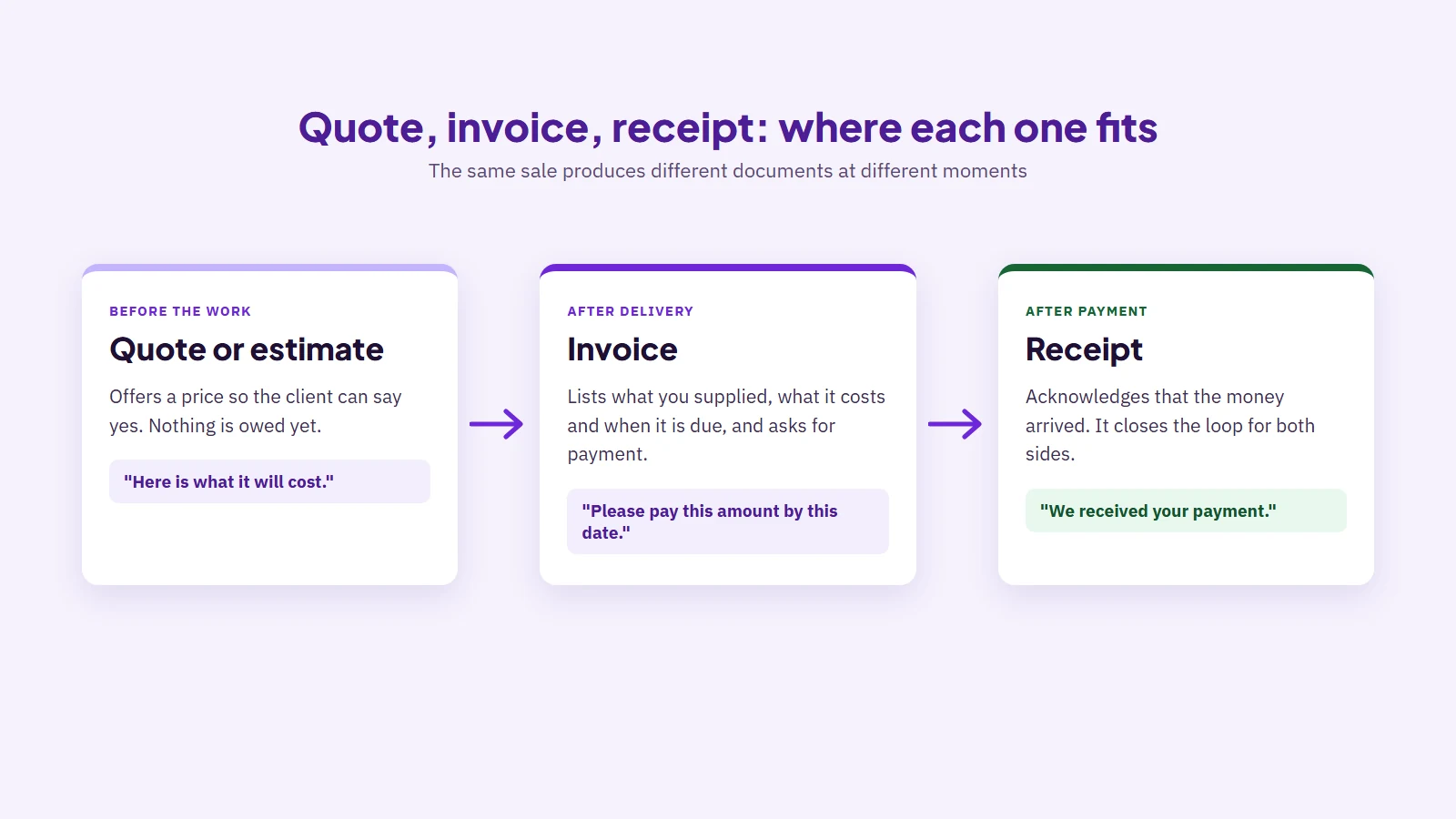
| Document | When it is sent | What it says | Is money owed? |
|---|---|---|---|
| Quote | Before the work | A price offered for a defined job | No, not until accepted and delivered |
| Estimate | Before the work | A best guess that may change | No |
| Invoice | After delivery (or by agreed milestone) | What was supplied, what it costs, when to pay | Yes |
| Receipt | After payment | Confirms the payment arrived | No, it is settled |
| Bill | Any time | Everyday word for a request to pay | Yes |
"Bill" and "invoice" are often used as synonyms. In practice, "bill" is the everyday word (a restaurant bill, a phone bill), while "invoice" is the business term, usually with a number, itemized lines and payment terms. From the buyer's point of view, an invoice they receive is a bill to pay.
If you need the documents on either side of the invoice, the quote maker and estimate maker cover the "before" stage, and the receipt maker covers the "after". For more detail, see our guides on how to format a quotation and writing a receipt of payment.
Common types of invoices
Most of the invoice types you will see are the standard invoice with a different job or a different moment in its life. The core invoice meaning stays the same. The ones worth knowing:
Types by purpose
- Standard invoice. The everyday request for payment after delivery.
- Pro forma invoice. A preliminary invoice sent before the sale is final. In trade, the US International Trade Administration describes it as "a quote in an invoice format" that a buyer may need to apply for an import license or open a letter of credit. Read more in our pro forma invoice guide.
- Commercial invoice. An export document. The ITA calls it "a required document for the export and import clearance process", used by customs in the buyer's country to assess duties and taxes. Our commercial invoice guide covers it.
- Recurring invoice. The same invoice sent on a schedule, for retainers, subscriptions or rent. Prima Invoice Pro can send recurring invoices for you.
- Interim or progress invoice. Bills part of a long project as milestones are reached, rather than everything at the end.
- Itemized invoice. Breaks the total into individual lines. Most clients and accounts teams expect this.
- Consolidated invoice. Combines several deliveries or orders for one client into a single invoice for the period.
- Debit note. A separate document that raises what a customer owes, for example to correct an undercharge. See the debit note guide.
- Electronic invoice (e-invoice). Not just a PDF sent by email. The European Commission defines eInvoicing as "the structured electronic exchange of invoice data between a supplier and a buyer," processed automatically. A PDF from an invoice generator is a digital invoice, not an e-invoice in that legal sense. Our e-invoicing guide explains the difference.
Status words: draft, open, paid, overdue
Some "types" are really statuses: they do not change the invoice meaning, only where the document is in its life. A draft invoice is still being edited and has not been sent. An open invoice has been sent and is not paid yet. A paid invoice has been settled in full, and you may send a receipt to confirm it. An invoice becomes overdue the day after its due date passes. A revised invoice replaces an earlier one that contained a mistake, ideally referencing the original number so nobody pays twice. If you send clients a running summary of several invoices and payments, that is a statement of account, not an invoice.
When and how to send an invoice
Send the invoice as soon as the work is delivered or the agreed milestone is reached. Every day you wait is a day added to the payment cycle, and clients tend to pay in the order invoices arrive.
Timing also matters legally in some places. In the UK, if no payment date is agreed, government guidance on late commercial payments says the payment is late 30 days after either the customer gets the invoice or you deliver the goods or service, whichever is later. That is UK-specific; other countries have different rules, so agree terms in writing before you start.
A short routine that works for most freelancers and small teams:
- Confirm the client's billing name, address and any purchase order number before the work ends.
- Create the invoice with a unique number, a clear description of each line, and a calendar due date.
- Export a PDF and send it to the person who approves payments, not only to your day-to-day contact.
- Include a way to pay: bank details, or a payment link from your own Stripe or PayPal account.
- Follow up politely a few days before the due date, and again the day after it passes. Payment reminders in Prima Invoice Pro can send these emails on schedule.
"Pay by invoice" is the arrangement behind all of this: the buyer receives goods or services first and pays later against the invoice, instead of paying upfront at checkout. It is normal in business-to-business work, and it is why a clear invoice matters so much. That is the practical invoice meaning for a seller: you are extending credit until it is paid.
Invoice in Spanish, French and other languages
Because invoices cross borders, people often look up the word in other languages. These are the common translations:
| Language | Word for invoice |
|---|---|
| Spanish | factura |
| French | facture |
| German | Rechnung |
| Portuguese | fatura |
| Indonesian | faktur, or tagihan for a bill |
| Hindi | बीजक (beejak), with "bill" also widely used |
So if you were wondering "invoice que es", it is a factura: a document that lists what was sold and asks for payment. The invoice meaning is the same everywhere, but the legal content of a tax invoice is set locally. A Spanish factura or a French facture for tax purposes has its own mandatory fields, so a translated template alone is not enough for a VAT-registered business in those countries.
Mistakes that delay payment
Most late payments we hear about are not disputes. They are invoices that got stuck. These are the mistakes that cause it:
- Vague descriptions. "Design work" makes an accounts team ask questions. "Homepage design, two concepts, approved 28 October" does not.
- No due date. Without one, your invoice joins the "whenever" pile.
- Wrong recipient. Your contact may love your work and still have no power to approve payment.
- Duplicate or missing numbers. A duplicate invoice number can get a genuine invoice rejected as a copy.
- Arithmetic that does not add up. One cent of rounding difference can send an invoice back for correction. Let a tool do the maths.
- No easy way to pay. If paying you takes effort, it waits.
A slightly contrarian point: design matters less than people think. Whatever the invoice meaning in your trade, clarity is what gets it paid. A plain, well-structured invoice with the right numbers gets paid as fast as a heavily branded one. Spend the effort on clarity first and add your logo second.
Make your first invoice
Now you know the invoice meaning, what goes on one, and how it differs from the documents around it. The quickest way to make it concrete is to make one. The Prima Invoice generator runs in your browser without an account: add your logo, line items, your own tax label and rate, a discount, any currency, and download a PDF. Use the receipt maker once the client has paid, or start from one of our invoice templates for your trade.
Frequently asked questions
What is an invoice in simple words?
An invoice is a document a seller sends to a buyer listing what was supplied, what it costs and when payment is due. It is a formal request for payment and a record of the sale for both sides.
Is an invoice the same as a receipt?
No. An invoice asks for payment before it has been made. A receipt confirms that payment was received. UK government guidance says an invoice is not the same as a receipt, which is an acknowledgement of payment.
What is the difference between an invoice and a bill?
They describe the same request to pay. "Invoice" is the business term, usually numbered and itemized with payment terms, while "bill" is the everyday word. An invoice you receive from a supplier is a bill you have to pay.
What does a paid invoice mean?
A paid invoice has been settled in full. In your books the amount moves out of accounts receivable, and you can send the client a receipt as confirmation.
Do I need a business to send an invoice?
Freelancers and sole traders send invoices all the time. What you must show on the invoice, such as a tax or VAT number, depends on your country and whether you are registered for tax, so check your local rules.
Can I make an invoice for free?
Yes. The Prima Invoice generator runs in your browser without an account. You add your details, line items, your own tax rate and currency, then download a PDF.
What is a vendor invoice?
It is the same document seen from the buyer's side. The seller calls it a sales invoice; the buyer that receives it calls it a vendor or supplier invoice, a bill to approve and pay. It sits in the buyer's accounts payable until it is paid.
When does an invoice become overdue?
The day after its due date passes. In the UK, if no payment date was agreed, GOV.UK guidance on late commercial payments says payment is late 30 days after the customer gets the invoice or you deliver, whichever is later. Other countries set their own rules, so agree terms in writing.
Sources
- Cambridge Dictionary, "invoice"
- GOV.UK, Invoicing and taking payment from customers: invoices, what they must include
- GOV.UK, Invoicing and taking payment from customers
- GOV.UK, Late commercial payments: charging interest and debt recovery
- International Trade Administration (trade.gov), Pro Forma Invoice
- International Trade Administration (trade.gov), Commercial Invoice
- European Commission, eInvoicing
- IRS, What kind of records should I keep
- IRS, Recordkeeping
- Cambridge Business English Dictionary, "net 30"