
Proforma Invoice: What It Is and How to Use One
Contents
- What is a proforma invoice?
- When businesses use a pro forma invoice
- What to include on a proforma invoice
- Proforma invoice vs invoice (and tax invoice)
- Pro forma vs commercial invoice
- Proforma invoice vs quote
- How to make a proforma invoice: a worked example
- Paying against a proforma invoice, and VAT
- Common pro forma mistakes
- Key takeaways
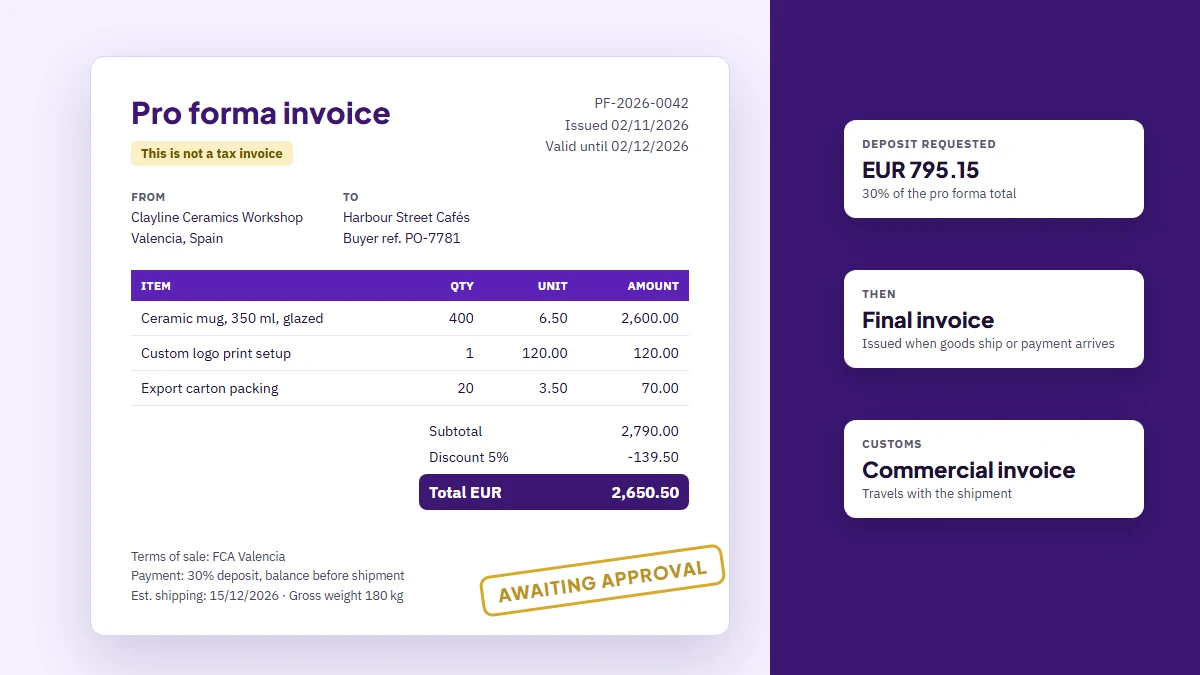
A proforma invoice is a preliminary bill that a seller sends before the goods ship or the work starts. It looks like an invoice, with prices, quantities and payment terms, but it is really a firm offer: it tells the buyer exactly what the final invoice will say, so they can approve the deal, pay a deposit, arrange financing or apply for an import licence. It does not create a debt the way a final invoice does, and in most VAT systems it cannot be used to reclaim tax.
That is the short answer. The rest of this guide covers when you need one, what goes on it, how it differs from a quote, a regular invoice and a commercial invoice, and a worked example with real numbers you can copy.
What is a proforma invoice?
The US International Trade Administration defines a pro forma invoice as "a quote in an invoice format". Buyers may need it to apply for an import licence, arrange a pre-shipment inspection, open a letter of credit or get approval to transfer foreign currency. The Cambridge Dictionary gives the everyday business meaning: an invoice, usually sent to a new customer, asking for payment before goods or services are supplied.
Put those two together and you get the definition of a proforma invoice that matters in practice. It is a document that describes a sale which has not happened yet, laid out the way the real invoice will be.
The Latin phrase "pro forma" means "as a matter of form". The document follows the form of an invoice without being the final one. You will see it written as proforma, pro forma and pro-forma. All three are correct, and the common shorthand is PI. "Performa invoice" is a frequent misspelling, so if a buyer asks for a "performance invoice", they almost always mean a pro forma.
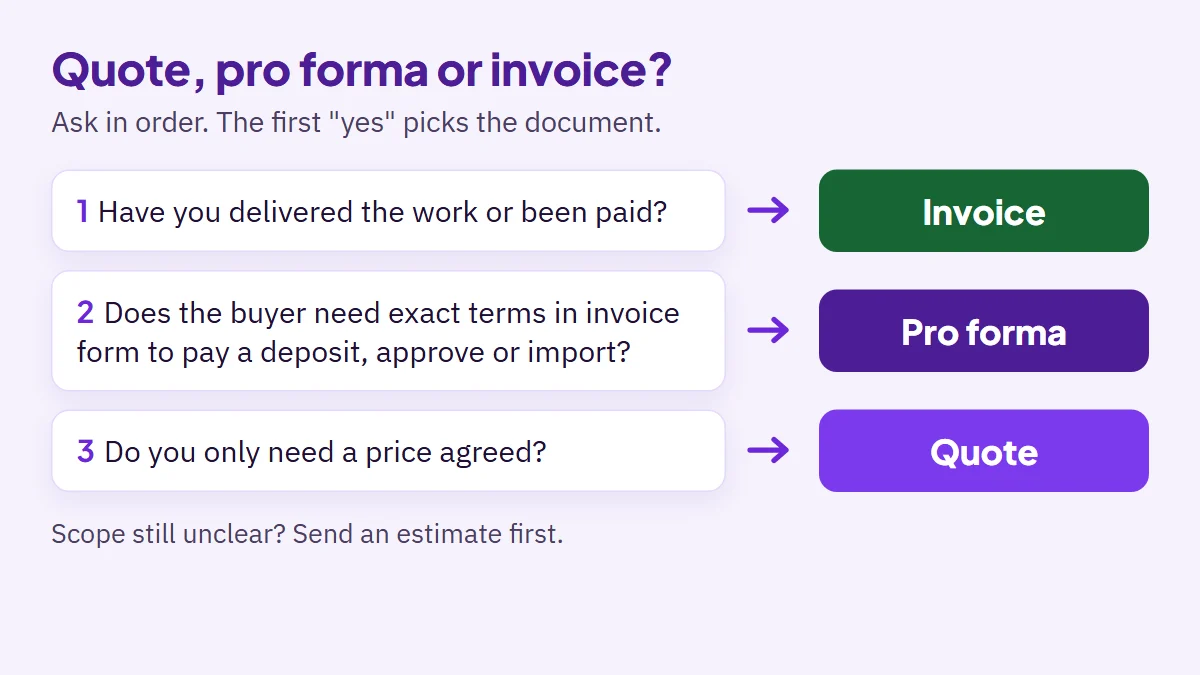
Our working rule: if money is owed because you already delivered, send an invoice. If money or approval is needed before you deliver, send a pro forma.
When businesses use a pro forma invoice
Pro forma billing shows up in two very different worlds, and it helps to know which one you are in.
Export and import deals
This is where the document has the most formal weight. An importer often cannot pay you, or even place the order, until their bank, customs broker or a government office sees the exact goods, prices and terms. The International Trade Administration notes that a pro forma may not be a required shipping document, but it gives buyers the detail they need to import the product legally. If you sell physical goods across borders, expect buyers to ask for one before they commit.
Advance payment from new or one-off clients
Freelancers, studios and small suppliers use a pro forma to ask for payment up front. A new client with no payment history, a large custom order, or a booking that blocks out your calendar are the usual triggers. The pro forma states the price, the deposit and what happens next, and the final invoice follows once the work is delivered or the deposit lands.
A third, quieter use is internal approval. Some companies cannot raise a purchase order until finance has an invoice-shaped document to attach. A proforma solves that without you issuing a real invoice for work you have not done.
One honest caveat: if your client already trusts you and pays on time, a pro forma can add a round of paperwork for no gain. A clear quote followed by an invoice is often enough. Use the pro forma when someone on the buyer's side actually needs it.
What to include on a proforma invoice
The International Trade Administration lists the points a pro forma should carry for an export sale. We use the same list for domestic deals and drop the shipping lines when they do not apply.
- Seller's name and address, and the buyer's name and address
- The buyer's reference, such as their enquiry or purchase order number
- The items quoted, with prices per unit and extended totals
- Weights and dimensions of the products
- Discounts, if any
- Terms of sale, meaning the Incoterm used and the delivery point
- Terms of payment, for example a 30% deposit with the balance before shipment
- An estimated shipping date and a validity date for the offer
Add three things the official list leaves implicit. First, a clear title that says "Pro forma invoice". Second, its own reference number, so nobody confuses it with your invoice sequence. Third, a line such as "This is not a tax invoice" if you are registered for VAT or GST. The UK tax authority asks for exactly that wording in its VAT guidance on pro forma invoices, covered further down.
Proforma invoice vs invoice (and tax invoice)
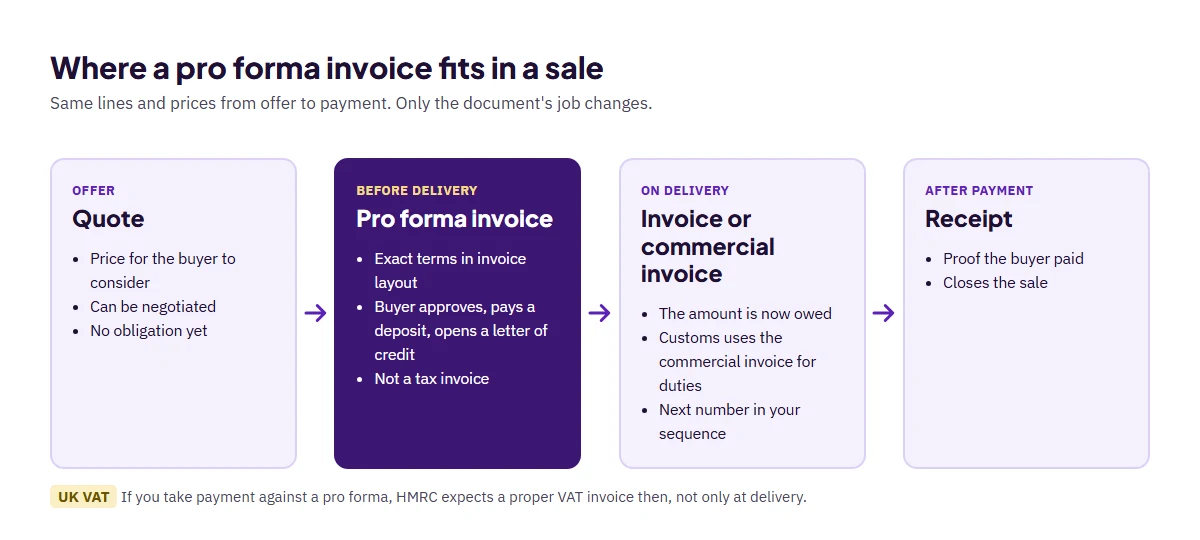
The difference between a proforma invoice and an invoice comes down to timing and obligation. An invoice records a sale that has happened and asks for payment that is now owed (our guide to what an invoice means covers the basics). A pro forma describes a sale that is about to happen. The buyer can still say no, change quantities or let it expire.
| Point | Pro forma invoice | Invoice or tax invoice |
|---|---|---|
| When it is sent | Before delivery or before work starts | After delivery, or when payment falls due |
| Creates a debt | No, it is an offer or request | Yes, the amount is owed |
| Numbering | Its own reference, outside the invoice sequence | Next number in your invoice sequence |
| Can the buyer reclaim VAT on it | No (UK HMRC guidance) | Yes, if it is a valid VAT invoice |
| Recorded as revenue | No | Yes |
| Can it change | Yes, revise and reissue | Usually corrected with a credit note or a debit note, not by editing |
Most of the confusion comes from the last row. Because a pro forma is not an accounting record, revising one is normal. Sellers routinely send a "revised proforma invoice" after a buyer changes quantities. Do that with a final invoice and you create a mess in your books; a final invoice that undercharged is put right with a separate debit note instead.
Pro forma vs commercial invoice
For exporters, this is the comparison that matters most. A commercial invoice is the final bill for goods that are actually shipping. The International Trade Administration calls it a required document for export and import clearance, and the one customs officials in the buyer's country use to assess import duties and taxes. It may also carry the Harmonized System (HS) code, the international product classification customs uses.
So the commercial invoice and the proforma invoice usually hold the same lines, but they do different jobs:
- The pro forma comes first. It lets the buyer approve, finance and license the purchase.
- The commercial invoice travels with the shipment. It is what customs relies on and what the buyer pays against.
- The figures should match. If something changes between the two, tell the buyer before shipping, because their import licence or letter of credit may be based on the pro forma.
There is one situation where a pro forma does go to customs. Under US rules (19 CFR 141.91), if the required commercial invoice is not available when an importer files the entry, US Customs and Border Protection can accept a pro forma invoice instead. The importer must declare they cannot produce the invoice and post a bond, and the real invoice must normally follow within 120 days. That is a fallback for the importer, not a shortcut for the seller. Send the proper commercial invoice with the goods.
Proforma invoice vs quote
A quote and a pro forma carry almost the same information. The International Trade Administration says pro forma invoices contain much of the same information as the formal quotation and can often be used in place of one. So what is the difference between a proforma invoice and a quotation?
In our view it is the stage of the deal (our guide to quotation format shows what a good quote carries). A quote opens the conversation: here is what it would cost. A pro forma closes it: here is exactly what you will be billed, laid out as an invoice, so you can pay or get approval. Some buyers treat them as the same document. When a buyer needs it for an import licence or a letter of credit, they will usually ask for a "pro forma invoice" by name, so use that title when that is what they requested.
If you only need a price agreed, a quote is enough. Our free quote maker handles that, the free quote template gives you a ready layout, and an estimate fits jobs where the final figure may move.
How to make a proforma invoice: a worked example
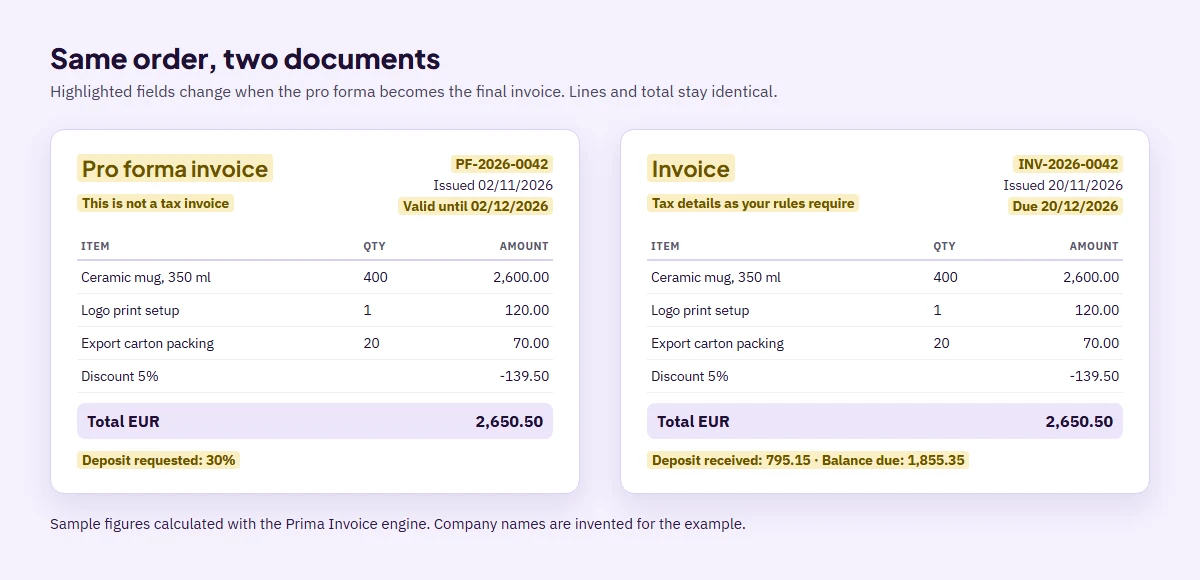
Here is a real example, worked through Prima Invoice's own calculation engine, the same code that totals every document in our generator. A ceramics workshop is selling branded mugs to a café chain abroad. The buyer needs a pro forma to approve the purchase and pay a deposit.
| Description | Quantity | Unit price (EUR) | Amount (EUR) |
|---|---|---|---|
| Ceramic mug, 350 ml, glazed | 400 | 6.50 | 2,600.00 |
| Custom logo print setup | 1 | 120.00 | 120.00 |
| Export carton packing | 20 | 3.50 | 70.00 |
| Subtotal | 2,790.00 | ||
| Discount, 5% first order | -139.50 | ||
| Total | 2,650.50 | ||
No tax line appears because this is a cross-border sale and the workshop's tax treatment is something it confirms with its own adviser. Prima Invoice never assumes a country rate. You type your own tax label and rate, per line or for the whole document, and the totals follow.
To build this yourself in Prima Invoice:
- Open the quote maker. We use the quote as the pro forma because, as the official definition says, a pro forma is a quote in an invoice format. Prima Invoice has no separate pro forma document type, and we would rather say so than pretend.
- Add your details and the buyer's, choose EUR (or any other currency), and enter the three lines and the 5% discount.
- Set the valid-until date, here 30 days, so the offer cannot be held open forever.
- In the notes, write "Pro forma invoice. This is not a tax invoice." Then add the Incoterm, the estimated shipping date, the deposit terms and the gross weight.
- Download the PDF and send it. If you take card or PayPal deposits, you can add your own Stripe or PayPal payment link. The money goes straight to your account; we never hold it.
When the buyer accepts, convert the quote into an invoice. The lines, discount, currency and total carry over unchanged (EUR 2,650.50 here), the number changes from QUO-2026-0042 to INV-2026-0042, and the due date is set from the payment terms. Once the balance is paid, the same data becomes a receipt. Exporters then add the HS codes and shipping details the commercial invoice needs.
Paying against a proforma invoice, and VAT
Advance payment against a pro forma is normal. The buyer pays the deposit or the full amount, then you deliver. What trips people up is tax.
In the UK, HMRC's VAT guide (Notice 700, section 17.3) says a pro forma used to offer goods or services cannot be used as evidence to reclaim input tax, even if it shows every detail a VAT invoice needs. Sellers should mark it "this is not a VAT invoice". Once you supply the goods or services, or receive payment, you must issue a proper VAT invoice.
That last sentence surprises many sellers. Under HMRC's guidance, taking the deposit is itself a trigger. Do not wait for delivery to send the real invoice. Other countries set their own VAT and GST rules, so check with your tax authority or adviser for yours. The safe habit everywhere is to keep the pro forma out of your invoice numbering and issue a real invoice as soon as money moves or goods leave.
From the buyer's side, paying against a proforma invoice means paying for something not yet received. Pay a known supplier, check the bank details by a second channel, and keep the pro forma with your later invoice so the two can be matched.
Common pro forma mistakes
These are the problems we see most often when people bring their pro formas into an invoice generator:
- Using the invoice number sequence. The pro forma takes INV-0105, the deal falls through, and now there is a gap in your invoice numbers that you have to explain. Give pro formas their own series.
- No validity date. Prices for materials and freight move. Without a date, a buyer can come back months later expecting the old price.
- Treating it as the final invoice. The buyer pays and the seller never issues the real invoice. That leaves the buyer unable to reclaim VAT and leaves gaps in your records.
- Figures that drift. A revised pro forma goes to the buyer, but the commercial invoice repeats the old numbers. If the buyer's letter of credit or import licence was based on the pro forma, a mismatch can hold up payment or clearance.
- Missing the deposit terms. "Payment in advance" without an amount or a deadline invites back-and-forth. Write the percentage, the amount and the date.
None of these need software to fix. They need a habit: one document per stage, a number for each, and the same data carried forward rather than retyped.
Key takeaways
A proforma invoice is an invoice-shaped offer. Use it when a buyer needs exact terms before they can pay, approve or import, or when you want payment before you start. Fill it in like an invoice, title it clearly, number it separately, add a validity date and "this is not a tax invoice", and follow it with a real invoice once goods ship or money arrives.
If you want to try the example above, open the quote maker or the free invoice generator. Both work in your browser without an account, and you can download a PDF. For ready-made layouts, browse our invoice templates.
Frequently asked questions
Is a proforma invoice legally binding?
Not in the way an invoice is. A pro forma is an offer or a request for payment before supply, so it does not record a debt. Once the buyer accepts it, it usually becomes part of the deal, and the International Trade Administration advises that changes should not be made without the buyer's consent. For anything contractual, follow the law that governs your sale.
Can I reclaim VAT on a proforma invoice?
In the UK, no. HMRC says a pro forma used to offer goods or services cannot be used as evidence to reclaim input tax, even if it shows every VAT invoice detail. The seller must issue a proper VAT invoice once the goods or services are supplied or payment is received. Other countries set their own rules.
Does a proforma invoice need an invoice number?
Give it a reference, but keep it out of your invoice sequence. A separate series such as PF-2026-0042 or a quote number avoids gaps in your invoice numbers when a deal does not go ahead.
What is the difference between a proforma invoice and a commercial invoice?
The pro forma comes before shipment so the buyer can approve, finance or license the purchase. The commercial invoice is the final bill that travels with the goods, and customs in the buyer's country uses it to assess duties and taxes.
Can I pay a proforma invoice?
Yes. Paying a deposit or the full amount against a pro forma is common, especially with new suppliers and export orders. Ask the seller for the final invoice afterwards, because that is the document your accounts and any tax reclaim rely on.
What does PI mean on an invoice?
PI is short for pro forma invoice. You will also see it spelled proforma, pro-forma or, by mistake, performa. They all mean the same preliminary, invoice-style document.
Can I change a proforma invoice after sending it?
Yes, by sending a revised pro forma with the same reference and a clear revision mark. The International Trade Administration says the pro forma informs the buyer and import authorities about the future shipment, and that changes should not be made without the buyer's consent, so agree the change first.
Can a proforma invoice be used for customs clearance?
Normally the commercial invoice is the customs document. Under US rules (19 CFR 141.91), customs can accept a pro forma invoice when the commercial invoice is not available at entry, but the importer must post a bond and the real invoice must normally follow within 120 days. Sellers should still send a proper commercial invoice with the goods.
Sources
- International Trade Administration (trade.gov): Pro Forma Invoice
- International Trade Administration (trade.gov): Commercial Invoice
- HMRC: VAT guide (VAT Notice 700), section 17.3 Pro-forma invoices
- US Code of Federal Regulations, 19 CFR 141.91: Entry without required invoice (govinfo.gov)
- Cambridge Dictionary: pro forma invoice