
E-Invoicing Explained: E-Invoices vs PDF Invoices, EN 16931 and Peppol
Contents
- What is e-invoicing?
- E-invoice vs PDF invoice: why a PDF does not count
- EN 16931: the e-invoice format the EU uses
- Peppol e-invoicing: how the network works
- E-invoicing in the EU: what the rules say
- E-invoicing outside the EU: two more examples
- Benefits of electronic invoicing (and when they are small)
- Do you need e-invoice software? A quick checklist
- Worked example: a PDF invoice and its e-invoice fields
- Where Prima Invoice fits, honestly
- Conclusion
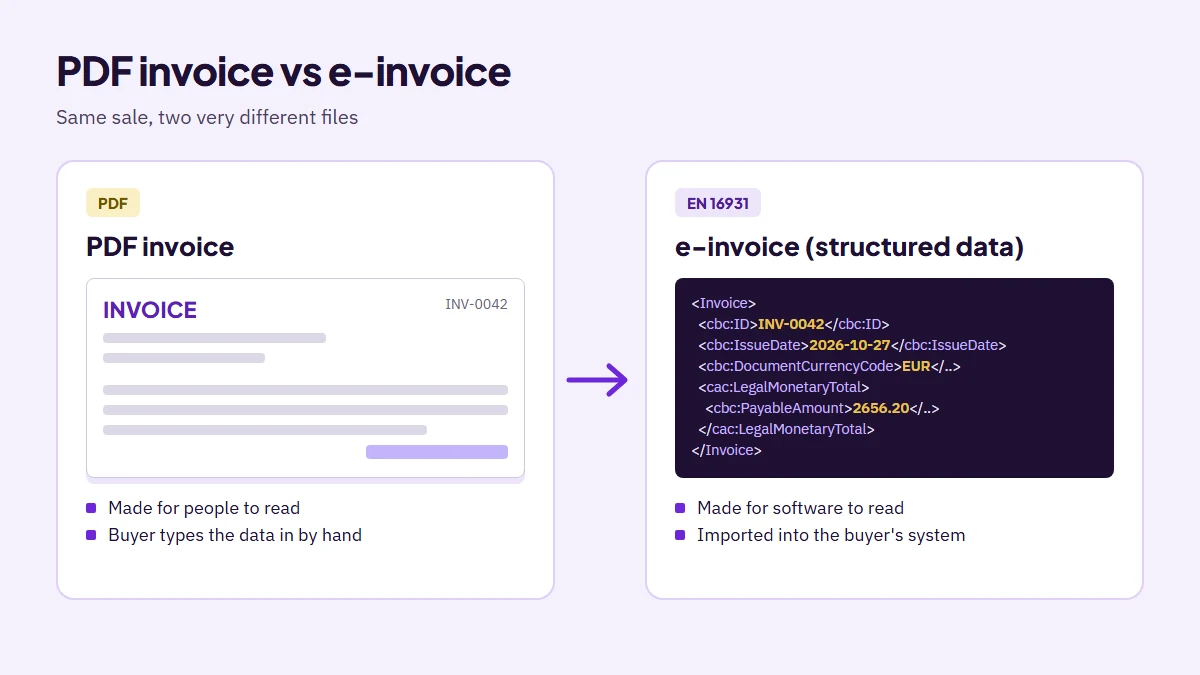
E-invoicing (also written e invoicing, short for electronic invoicing) is the exchange of invoice data between a seller's software and a buyer's software in a structured format that a computer can read and process without anyone retyping it. A PDF invoice sent by email is not an e-invoice in this sense, even though it is digital. In the EU, an e-invoice usually follows the European standard EN 16931 and often travels over the Peppol network.
This guide explains what counts as an electronic invoice, how EN 16931 and Peppol fit together, what EU rules require today and from 2030, and how to tell whether your business needs e-invoicing software yet. One honest note before we start: Prima Invoice makes PDF invoices, quotes, estimates and receipts. It does not create structured e-invoices, so we will also tell you when a PDF is enough and when it is not.
What is e-invoicing?
The European Commission describes it in one sentence: "eInvoicing is the structured electronic exchange of invoice data between a supplier and a buyer, enabling full automation of processing without manual input." The legal definition comes from Directive 2014/55/EU: an electronic invoice is "an invoice that has been issued, transmitted and received in a structured electronic format which allows for its automatic and electronic processing".
The key word is structured. In an e-invoice, every piece of information sits in a labelled field: the invoice number, the issue date, the seller's VAT number, each line item, each tax amount, the total. The buyer's accounts payable system reads those fields directly. Nobody has to look at the invoice and type the numbers into a ledger.
So what is an electronic invoice in everyday terms? Think of it as an invoice written for software first and people second. It may come with a readable copy, but the data file is the invoice.
That is why people use several terms loosely. "Digital invoices" and "digital invoicing" usually mean any invoice that is not on paper, including PDFs. "E-invoice" and "electronic invoice" in tax and procurement rules mean the structured kind. When an official rule says "e-invoice", read it as structured data, not as "an invoice sent by email".
Key takeaway: if a person has to read the invoice to get the numbers into the buyer's books, it is a digital invoice, not an e-invoice. If the buyer's software can import it field by field, it is an e-invoice.
E-invoice vs PDF invoice: why a PDF does not count
This is the point most articles skip, and it causes real confusion. The Commission's own "What is eInvoicing" page lists what eInvoices are not: "Unstructured invoice data issued in PDF or Word formats", "Images of invoices such as JPG or TIFF", "Unstructured HTML invoices on a web page or in an email", "OCR (Scanned paper invoices)" and "Paper invoices sent, like images, via fax machines."
The same page explains why. PDF and other visual formats "still require the invoice to be manually viewed and their data to be manually read and entered into AP systems." An e-invoice, by contrast, contains the data "in a structured form" and "can be automatically imported into AP systems."
The Australian government says the same thing in plainer words on business.gov.au: "eInvoices are not PDF invoices that need to be printed, posted or emailed."
| Question | PDF invoice | E-invoice (structured) |
|---|---|---|
| Who is it written for? | A person reading it | The buyer's software |
| How does the buyer record it? | Someone types or scans the data in | Imported field by field |
| Typical format | PDF, Word, image | XML such as UBL, following EN 16931 |
| How is it sent? | Email, download link, post | A network such as Peppol, or a government platform |
| Counts as an EU "electronic invoice"? | No | Yes, if it meets the standard |
There is one nuance worth knowing. Under the EU's 2025 VAT reform, "hybrid invoices combining data embedded in a structured format and data embedded in an unstructured, human-readable format" can count, but only "if such invoices include all the data to be reported in a structured format" (Council Directive (EU) 2025/516, recital 9). In other words, a PDF can carry an e-invoice inside it. A plain PDF on its own still does not qualify.
EN 16931: the e-invoice format the EU uses
When people ask about the "e invoice format", in Europe the answer is EN 16931. According to the Commission's page on the standard, it "was developed and published by the European Committee for Standardization (CEN), at the request of the European Commission."
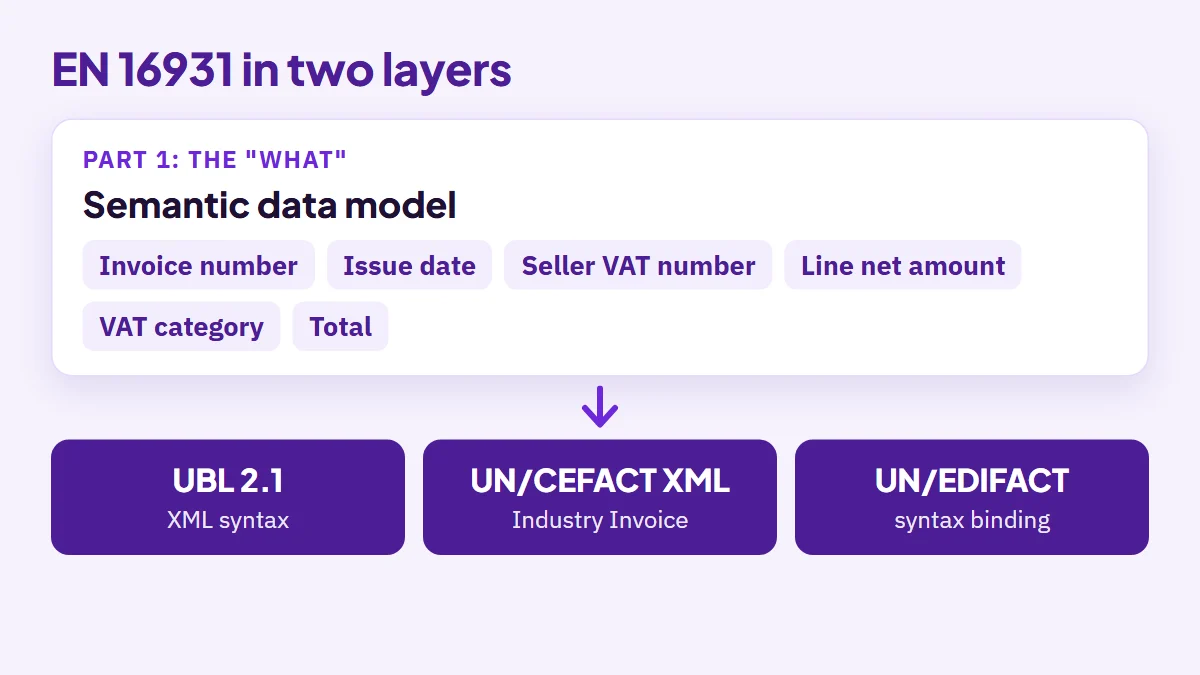
EN 16931 works in two layers, and this is where most explanations get muddy:
- The semantic data model (part 1). This is the list of business terms an invoice can contain and what each one means: seller name, buyer reference, line net amount, VAT category, and so on. It is the "what".
- The syntaxes (part 2 and the syntax bindings). These are the actual file formats that carry the data. The bindings listed by the Commission cover UBL 2.1 (ISO/IEC 19845), UN/CEFACT XML Industry Invoice and UN/EDIFACT. This is the "how".
Parts 1 and 2 are free to access under a 2018 licence agreement between the Commission and CEN. The other parts are sold through national standards bodies.
The standard is also changing right now. The Commission page states that "A new version of the EN 16931-1, a version 2026, was published in May 2026 and consequently the 2017 version of the EN 16931-1 has been formally withdrawn." It adds that "The 2017 version will, however, remain compliant during the migration period." If you are buying e-invoicing software in late 2026, ask the vendor how and when they will move to the 2026 version.
Our opinion, after building invoice calculations from scratch: the data model is the valuable part, even for businesses that only send PDFs. It forces clear answers to questions a PDF lets you dodge, such as whether a discount applies before or after tax, and which tax rate applies to which line.
Peppol e-invoicing: how the network works
EN 16931 tells you what an e-invoice contains. Peppol is one widely used way to deliver it. Business.gov.au calls Peppol "a common standard in Australia (and many other countries)" and explains that "your software needs to be connected to the Peppol network where eInvoices are delivered securely by Australian Taxation Office (ATO) approved service providers."
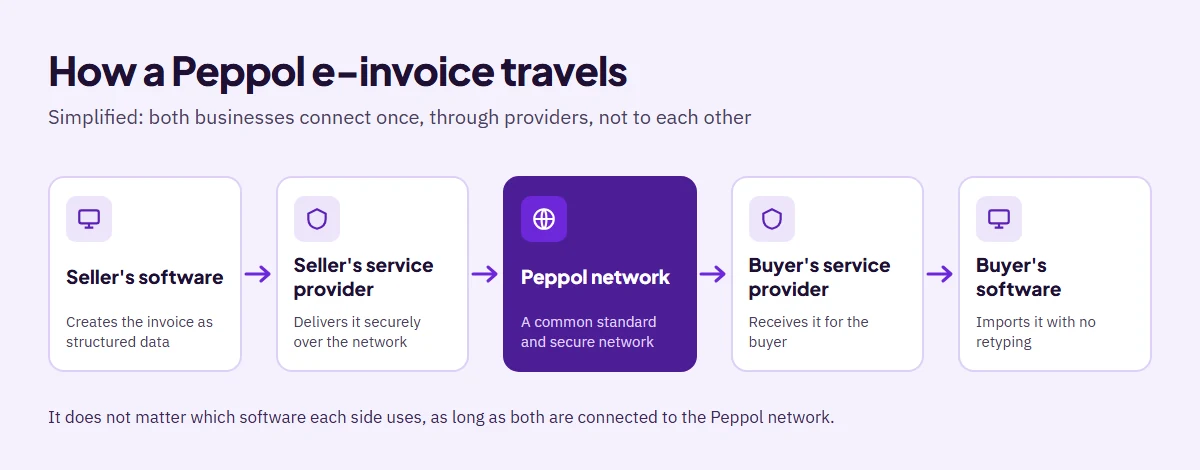
The useful idea here is that you connect once. The same page notes: "It doesn't matter which software you and your business partners use to invoice, as long as you're both connected to the Peppol network." That is very different from email, where every buyer may want invoices in a different place and format.
Peppol also has its own invoice specification, Peppol BIS Billing 3.0. Its documentation says it "is a Core Invoice Usage Specification (CIUS) of EN 16931" and that "Any instance documents compliant to this specification will be compliant with the European Standard (EN 16931)." A CIUS is a stricter profile of the standard: it keeps the same fields but adds rules. One example rule in the spec: "An invoice shall have a buyers reference or an order reference."
That last rule is a good preview of what changes when you move to Peppol invoicing. A PDF with a missing purchase order number still gets delivered and argued about later. A Peppol invoice is expected to pass those rules, and the specification publishes them as validation files that software can run automatically.
E-invoicing in the EU: what the rules say
EU e-invoicing rules have grown in three stages. Each stage widened who has to send or accept structured invoices.
Public procurement (B2G)
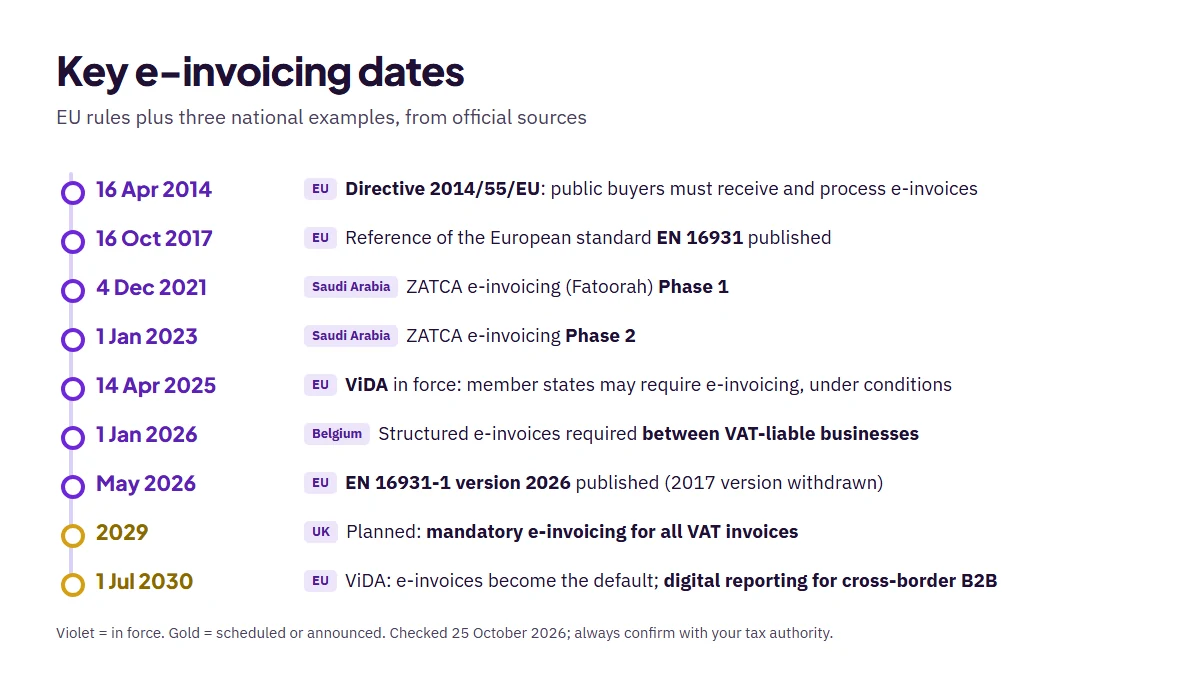
Directive 2014/55/EU, Article 7, requires that "contracting authorities and contracting entities receive and process electronic invoices" that comply with the European standard. This is an obligation to receive, aimed at public buyers. Countries can go further and require suppliers to send e-invoices to government. The Commission's eInvoicing page currently counts 21 countries that "introduced obligations for issuing B2G eInvoices".
The Commission also plans to replace the 2014 Directive "with a Regulation that makes the European standard mandatory for public procurement (Q4 2026)". At the time of writing, that is a plan, not adopted law.
VAT in the Digital Age (ViDA)
The bigger change for ordinary businesses is the ViDA package. The Commission's ViDA page says it "was adopted on 11 March 2025" and that "Upon entry into force (14 April 2025), Member States are able to introduce mandatory e-invoicing under specific conditions." Under the amended Article 232 of the VAT Directive (Directive (EU) 2025/516), a country using that option can make e-invoices between businesses established there no longer depend on the recipient accepting them.
The next milestone is 1 July 2030. From that date, according to the same page, "Digital Reporting Requirements will affect cross-border B2B transactions." The directive's new Article 218 also states that "invoices shall be issued as electronic invoices", while still letting member states "accept documents or messages on paper or in electronic formats other than electronic invoices for transactions not subject to the reporting obligations." Electronic invoices then "shall comply with the European standard on electronic invoicing", although countries may allow other standards for domestic supplies.
Why is the EU doing this? The Commission expects the move to e-invoicing to "help reduce VAT fraud by up to €11 billion a year" and to cut compliance costs for EU traders "by over €4.1 billion per year over the next ten years." The tax angle matters: these mandates exist mainly so tax authorities get transaction data quickly, and faster processing for businesses is the side benefit.
A national example: Belgium
Belgium is a clear case of a country using its new freedom. The official e-invoice portal says: "Since 1 January 2026, all Belgian enterprises liable to VAT will have to use structured electronic invoices in their transactions with each other." The portal also announced a period of tolerance during the first three months of 2026. If you sell to Belgian VAT-registered businesses, check the portal's FAQ for whether the obligation covers you.
E-invoicing outside the EU: two more examples
E-invoicing mandates are not only European. We picked two examples where we could read the rule on an official government page.
United Kingdom. A GOV.UK consultation page, Promoting electronic invoicing across UK businesses and the public sector, states: "As announced at Budget 2025, the UK will introduce mandatory e-invoicing for all VAT invoices from 2029". The same page says a roadmap would be published at Budget 2026. Until that detail is final, UK businesses can keep sending PDF invoices, but it is sensible to choose accounting tools with e-invoicing on their roadmap.
Saudi Arabia. The Zakat, Tax and Customs Authority (ZATCA) describes e-invoicing as converting paper invoices and notes "into an electronic process that allows the exchange and processing of invoices, credit notes & debit notes in a structured electronic format" (our debit note guide explains that document). Its Fatoorah programme rolled out in two phases: Phase 1 on 4 December 2021 and Phase 2 on 1 January 2023. ZATCA also notes that taxpayers "may choose any e-invoicing solution provider as long as it is compliant with the e-invoicing requirements."
Other countries run their own national systems, and the rules differ on format, timing and who is covered. If you invoice in a country not listed here, go straight to that country's tax authority website rather than a vendor blog. Vendors have a reason to make every mandate sound urgent.
Benefits of electronic invoicing (and when they are small)
The official sources agree on the main benefits. The Commission says e-invoicing "Delivers immediate cost savings", "Automates invoice processing and exchange" and "Facilitates VAT automation." Business.gov.au lists more accurate invoices, less time fixing errors, "no more lost invoices", "less chance of invoice fraud or scams" and "faster payments".
Most of those benefits land on the buyer's side, in accounts payable. A company receiving thousands of supplier invoices a month saves real money when nobody has to key them in. That is why large buyers and governments push e-invoicing first.
Here is our more cautious take for small sellers. If you are a freelancer who sends eight invoices a month to a handful of clients, structured e-invoicing will not save you much time by itself. Your bottleneck is usually chasing payment, not data entry, which automatic payment reminders help with far more. The benefit for you is access: some buyers, and in some countries the law, will simply require it. Business.gov.au also notes that its eInvoicing "does not apply to business to consumer transactions", so a small B2C business may feel almost no change.
Pro tip: before paying for e-invoice software, ask your three biggest clients how they want to receive invoices. If none of them mention Peppol or a government platform, and your tax authority does not require it yet, a clear PDF invoice is still the faster route to getting paid.
Do you need e-invoice software? A quick checklist
E-invoice software (sometimes called an e invoicing system or e-billing system) is what creates the structured file and connects you to a network or government platform. You probably need it if any of these is true:
- You sell to public bodies in a country that requires suppliers to send B2G e-invoices.
- You are VAT-registered in a country where B2B e-invoicing is already mandatory, such as Belgium since 1 January 2026.
- You are registered for VAT in Saudi Arabia and fall under ZATCA's e-invoicing rules.
- A large client asks you to send invoices through Peppol or its supplier portal.
- You trade across EU borders and are planning for the July 2030 reporting rules.
If none of these apply today, you can usually keep issuing PDF invoices where your tax authority accepts them. Check the rules for your country before you rely on that, because they are changing quickly.
If you do need it, start with the accounting software you already use. Business.gov.au notes that "Many small business accounting software providers already offer eInvoicing options." Switching your whole bookkeeping stack just to get a Peppol connection is rarely necessary. Look for software that names EN 16931, Peppol BIS Billing 3.0 or your national platform explicitly, not just "digital invoices".
Worked example: a PDF invoice and its e-invoice fields
To make the difference concrete, here is a real calculation from the invoice engine behind the Prima Invoice generator. A freelance designer bills a client in euros, on the same layout as our graphic design invoice template. Taxes in our generator are entered by the user, so the 20% VAT below is simply the rate typed in for this example, not a rate we recommend for any country.
| Line | Qty | Unit price | Amount |
|---|---|---|---|
| Logo design | 1 | €1,200.00 | €1,200.00 |
| Brand guidelines (hours) | 8 | €85.00 | €680.00 |
| Social media kit | 1 | €450.00 | €450.00 |
| Subtotal | €2,330.00 | ||
| Discount 5% | -€116.50 | ||
| VAT 20% on €2,213.50 | €442.70 | ||
| Total due | €2,656.20 | ||
Our engine rounds each line to the cent, adds the lines, applies the discount, then calculates tax on the discounted amount. We ran this exact example through it while writing this guide, and the figures above are its output.
As a PDF, this invoice is ready to send. The client reads it, and their bookkeeper types €2,656.20 and the VAT amount into their system. As an e-invoice, the same numbers would sit in labelled fields instead. The hero image at the top of this guide shows a few of them in UBL: cbc:ID for the invoice number, cbc:IssueDate, cbc:DocumentCurrencyCode and cbc:PayableAmount.
A Peppol version would also need data a simple PDF can leave out. For example, it must carry a buyer reference or an order reference. Our 5% discount would also need its own VAT category code, because the Peppol rules say each document level allowance "must have" one. Peppol even publishes its rules as machine-readable validation files. That is the practical gap between "a correct invoice" and "a valid e-invoice": the second one is checked by software that does not guess.
Where Prima Invoice fits, honestly
Prima Invoice is a PDF invoicing tool. The free generator creates invoices, quotes, estimates and receipts in your browser, with any currency and the tax labels and rates you type in. It does not create EN 16931 e-invoices, it is not connected to Peppol, and it does not submit invoices to any government platform.
That makes it a good fit when a PDF is what your client and your tax authority accept, which is still the case for many freelancers and small businesses. It is the wrong tool when you are required to send structured e-invoices. In that case, use accounting software connected to Peppol or to your country's platform.
If you are not sure which documents you need yet, our guides on what an invoice must include, when to use a proforma invoice, what a commercial invoice needs for customs and recipient created tax invoices cover the basics that apply whether the invoice ends up as a PDF or an e-invoice. You can also browse ready-made invoice templates.
Conclusion
E-invoicing means structured invoice data that software can read on its own, not a PDF sent by email. In Europe that usually means EN 16931, often delivered over Peppol. Public buyers in the EU must already accept e-invoices, countries like Belgium now require them between businesses, and ViDA makes e-invoices the EU default from 1 July 2030, with cross-border reporting starting then.
For many small businesses, the right move today is to keep invoicing clearly, watch your own country's tax authority, and switch to e-invoice software when a client or the law asks for it. Until then, you can create a clear PDF invoice for free and send it in minutes.
Frequently asked questions
Is a PDF invoice an e-invoice?
No. The European Commission lists "unstructured invoice data issued in PDF or Word formats" among the things that are not eInvoices. An e-invoice is structured data, such as a UBL file following EN 16931, that the buyer's software can import without retyping. A PDF can carry an e-invoice inside it as a hybrid invoice, but a plain PDF does not qualify.
Is e-invoicing mandatory in the EU?
It depends on who you sell to and where. Under Directive 2014/55/EU, public buyers must receive and process e-invoices that meet the European standard. Since the ViDA reform entered into force on 14 April 2025, member states can make B2B e-invoicing mandatory under conditions, as Belgium did from 1 January 2026. From 1 July 2030, ViDA makes e-invoices the default and adds digital reporting for cross-border B2B sales.
What is Peppol e-invoicing?
Peppol is a common standard and secure network for exchanging e-invoices. Each business connects once through a service provider and can then exchange invoices with anyone else on the network, whatever software they use. Peppol's invoice specification, Peppol BIS Billing 3.0, is a stricter profile of EN 16931.
What format is an e-invoice?
In Europe, the content follows the EN 16931 data model, and the file uses one of the syntaxes bound to it, most often UBL 2.1 XML or UN/CEFACT XML Industry Invoice. Other countries use their own national formats, so check your tax authority's specification.
Does e-invoicing apply to sales to consumers (B2C)?
Usually much less. Australia's business.gov.au says its eInvoicing "does not apply to business to consumer transactions", and the EU ViDA rules focus on invoices to businesses and legal persons. Some countries have their own B2C rules, so check locally.
Can Prima Invoice create e-invoices?
No. Prima Invoice creates PDF invoices, quotes, estimates and receipts. It does not produce EN 16931 files, is not connected to Peppol and does not submit invoices to any government platform. Use it where a PDF invoice is accepted, and use accounting software connected to Peppol or your national platform when structured e-invoices are required.
Is e-invoicing mandatory in the UK?
Not yet. A GOV.UK consultation page states that, as announced at Budget 2025, the UK will introduce mandatory e-invoicing for all VAT invoices from 2029, with a roadmap to be published at Budget 2026. Until the detail is final, UK businesses can keep sending PDF invoices.
What is EN 16931?
EN 16931 is the European standard for electronic invoices, developed by the European Committee for Standardization (CEN) at the request of the European Commission. Part 1 is the semantic data model, the list of business terms an invoice can contain; the syntaxes, such as UBL 2.1, are the file formats that carry them. A 2026 version of part 1 was published in May 2026.
Sources
- European Commission, eInvoicing (Digital Building Blocks)
- European Commission, What is eInvoicing
- European Commission, Obtaining a copy of the European standard on eInvoicing (EN 16931)
- EUR-Lex, Directive 2014/55/EU on electronic invoicing in public procurement
- EUR-Lex, Council Directive (EU) 2025/516 (VAT in the Digital Age)
- European Commission, Taxation and Customs Union: VAT in the Digital Age (ViDA)
- OpenPeppol, Peppol BIS Billing 3.0 specification
- business.gov.au (Australian Government), eInvoicing
- Belgian Federal Public Service Strategy and Support, e-invoice portal
- GOV.UK, Promoting electronic invoicing across UK businesses and the public sector
- ZATCA (Saudi Arabia), E-Invoicing