
Consulting Invoice Template
A consulting invoice template is a bill for advisory work that ties every charge to the engagement the client signed: the period covered, the hours or days spent on each workstream, any retainer or fixed project fee, and reimbursable expenses at cost. It shows your firm and the client's details, a purchase order or engagement reference, the invoice number and due date, and the total. Open the prefilled version online, or download it for Excel, Word or as a blank PDF.
Free, no account. Opens the invoice generator with these lines filled in.
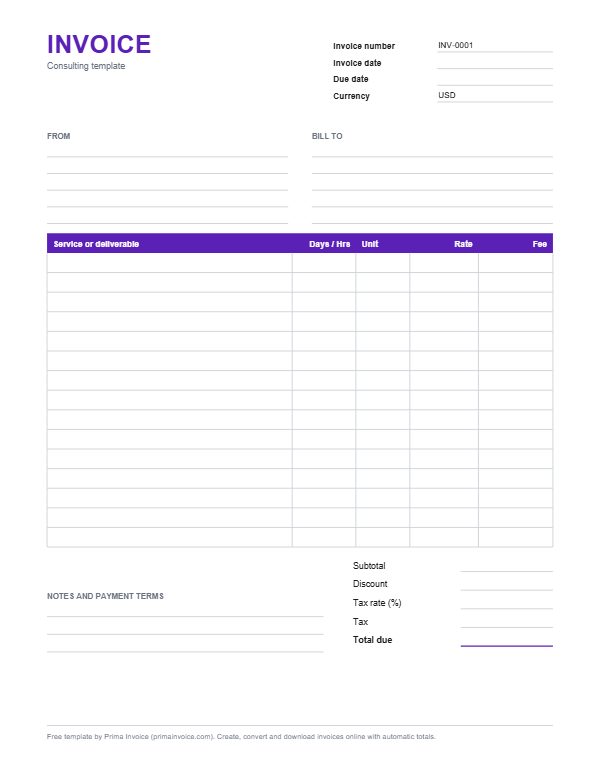
Example consulting invoice
These are typical lines for this kind of work. Edit, delete or add lines once the template is open.
| Service or deliverable | Days / Hrs | Unit | Rate | Fee |
|---|---|---|---|---|
| Strategy retainer, October (up to 20 hours) | 1 monthat $4,000.00 | month | $4,000.00 | $4,000.00 |
| Additional advisory hours beyond retainer | 6 hourat $225.00 | hour | $225.00 | $1,350.00 |
| Stakeholder interviews and synthesis | 2 dayat $1,600.00 | day | $1,600.00 | $3,200.00 |
| Leadership workshop facilitation | 1 dayat $1,800.00 | day | $1,800.00 | $1,800.00 |
| Written recommendations report | 1 deliverableat $2,500.00 | deliverable | $2,500.00 | $2,500.00 |
| Travel: return flight, at cost | 1 tripat $412.80 | trip | $412.80 | $412.80 |
| Hotel, two nights, at cost | 2 nightat $189.00 | night | $189.00 | $378.00 |
| Subtotal before tax | $13,640.80 | |||
Typical columns on a consulting invoice
| Column | What to put in it |
|---|---|
| Service or deliverable | Mirror the workstreams in your statement of work: "Market sizing analysis", "Board workshop facilitation", "Interim report". |
| Days or hours | Consultants often bill by the day for on-site work and by the hour for remote advice. Use whichever your engagement letter specifies. |
| Rate | The day rate, hourly rate or fixed fee agreed in the proposal. Rates for different seniority levels belong on separate lines. |
| Fee | Quantity multiplied by rate, worked out automatically in the generator and the spreadsheet. |
| Period covered | The dates the invoice relates to, such as "1 to 31 October". Put it in the notes or at the start of each line description. |
| PO or engagement reference | Corporate clients route invoices by purchase order or project code. Without it, the invoice may sit in a queue. |
How consulting invoices differ from other service bills
A consultant sells judgement, time and outputs that are often intangible. The client's finance team cannot inspect a finished wall or a delivered logo, so the invoice has to make the value traceable to the paperwork they already approved: the proposal, the statement of work and any change requests. Line descriptions that echo those documents are the single biggest factor in getting a consulting bill approved first time.
Consulting engagements also mix billing models. A typical month might include a fixed retainer, overflow hours, a day of on-site workshops and some travel. Each model should sit on its own line so nobody has to reverse-engineer how the total was built.
Larger organisations run accounts payable as a process with several approvers. Your contact may love your work and still be unable to pay you until procurement matches your invoice to an open purchase order, a supplier record and a cost centre. Ask about that process during onboarding, not after the first invoice bounces.
Retainers, day rates and fixed project fees
Retainers buy availability. State what the retainer covers, usually a number of hours or a scope of standing advice, and invoice it at the start of each period. If the client uses more than the allowance, bill the extra hours on a separate line at the agreed overflow rate. If they use less, your agreement decides whether unused hours roll over; say so in the notes to avoid end-of-quarter debates.
Day rates suit workshops, site visits and intensive sprints. A day usually means a defined number of hours, often seven or eight; define it in your terms so a twelve-hour offsite does not become an argument.
Fixed project fees work best when the deliverable is well defined. Bill them as milestones: a percentage on kickoff, another on the interim findings, the rest on the final report. Each invoice names the milestone and the percentage, so the client can see where the project stands financially at a glance.
Reimbursable expenses and how to show them
Travel, accommodation, research databases, survey panels and printing are often billed back to the client. Most engagement letters say whether expenses are reimbursed at cost, subject to a cap, or covered by a flat per-diem. Follow that rule exactly and label each line "at cost" where applicable.
Keep scanned receipts and attach them when the client's policy requires it. Group small items sensibly, for example one line for a week of taxis, rather than listing twenty receipts individually.
If expenses are incurred in another currency, convert them using a documented rate and mention the original amount in the description, such as "Hotel, EUR 174 converted at the card statement rate". Transparency here prevents a lot of back-and-forth.
Payment terms that suit corporate clients
Net 30 is a common term in business-to-business consulting: it means the invoice should be paid within 30 days. Some companies insist on their own standard terms, which can be longer. The law in some places limits how long businesses may take; for example, under the current EU late payment directive, contractual payment periods between businesses should not exceed 60 calendar days unless expressly agreed and not grossly unfair to the creditor.
Print the actual due date on the invoice, not just the term, and send it as soon as the period or milestone closes. A consultant who invoices on the first working day of every month is paid far more predictably than one who batches invoices whenever there is time.
Being clearly independent
Your invoices also tell a story about your working relationship. In the United States, the IRS general rule is that someone is an independent contractor if the client controls or directs only the result of the work, not what will be done and how. Invoicing for defined deliverables and your own expenses, from your own business, on your own terms, is consistent with that picture. It is not proof of status on its own, and your contract and actual working practices matter more, so take advice if your engagement is long and full-time.
Use your business name, your own invoice numbering and your own payment terms rather than the client's internal timesheet format wherever possible.
A worked example from the sample lines
The sample shows an October invoice for a strategy engagement: a $4,000 monthly retainer covering up to 20 hours, six overflow hours at $225 ($1,350), two interview days at $1,600 ($3,200), a $1,800 workshop day, a $2,500 report milestone, a $412.80 flight and two hotel nights at $189 ($378). The subtotal before tax is $13,640.80.
The figures illustrate the layout only. Consulting rates vary enormously by sector, seniority and region, so set yours from your own costs and positioning.
Time records that back up the invoice
Even on retainers and fixed fees, keep a simple log of dates, hours and activities. Clients rarely ask for it, but when they do, a tidy timesheet ends the conversation quickly. It also tells you which engagements are quietly unprofitable.
If the client requires timesheets with every invoice, attach them as a separate PDF and reference them in the notes: "Detailed time log attached". Keep the invoice itself readable with summarised lines.
Sending, tracking and chasing
Email the PDF to the accounts payable address and copy your sponsor. Put the invoice number and PO in the subject line. If the client uses a supplier portal, upload it there too and save the confirmation.
With a Prima Invoice account you can see when the invoice was opened, record partial payments, and schedule polite reminders before and after the due date. Recurring invoices handle monthly retainers automatically, as drafts to review or sent on the date you choose.
Value-based and success fees
Some advisers price on outcomes rather than effort: a fee tied to savings achieved, revenue unlocked or a funding round closed. If your agreement includes a success component, describe the trigger precisely on the invoice, for example "Success fee, 2% of the Series A amount, closing confirmed 12 September". Quote the clause number of the contract so procurement can verify the calculation without emailing you.
Because contingent fees are often large and arrive months after the work, agree in writing how the measurement is evidenced: an audited figure, a signed term sheet or a bank confirmation. Attach that evidence, or reference it, when you bill.
Non-profit, public sector and grant-funded clients
Charities, universities and government agencies frequently pay consultants out of restricted grants. Their auditors want to see which grant or budget line each cost belongs to, so ask for the code and include it. Public bodies may also publish supplier spending, require a registered vendor number, or mandate electronic submission through a procurement platform.
These clients often have fixed approval calendars, such as a committee that signs off invoices fortnightly. Find out the cut-off dates and time your billing to land just before them; a bill that misses the cycle by a day can wait two extra weeks.
Cross-border engagements
Advisers serving overseas organisations should state the currency explicitly and confirm who bears bank charges. Certain jurisdictions apply withholding tax on fees paid to foreign service providers, and treaties may reduce it; that is specialist territory, so ask an accountant before signing rather than discovering a deduction on remittance.
Associates and subcontracted specialists
Boutique firms often bring in associates: a data scientist, an economist, a facilitator. Bill their time under role titles at the rates in your proposal, for instance "Senior associate, analytics, 3 days". Whether you disclose names depends on your contract, but the role and rate should always be visible. Keep the associate's own bill to you on file, since your margin between their charge and yours is a legitimate business record, not something to hide from your accountant.
Pass-through software licences, survey incentives or translation work bought on the client's behalf follow the same logic as other reimbursables: label them, keep receipts, apply the agreed handling percentage if any.
Tips for your consulting invoice
Quote the PO on every invoice
No purchase order, no payment is the rule in many large companies. Ask for the PO before you start and add it to the notes of every invoice.
Bill at a predictable rhythm
Invoice retainers in advance and time-based work on the first working day after the period ends. Predictability trains clients to pay predictably.
Separate fees from expenses
Fees and reimbursables are often approved by different budgets. Distinct lines, labelled "at cost", speed up approval.
Name the period in the description
"Advisory hours, 1 to 31 October" removes any doubt about overlap with the previous invoice.
Agree late fees in the contract
If you want interest or fees on overdue invoices, put them in the engagement letter. Adding them for the first time on an overdue bill rarely works.
Mirror the proposal's role titles
If the proposal priced a partner day and an analyst day, the invoice should use those exact titles. Matching vocabulary lets approvers tick lines in seconds.
Frequently asked questions
What is the best way to invoice a consulting retainer?
Invoice the retainer at the start of each period as one line that states what it covers, for example up to 20 hours of advice. Bill any extra hours on a separate line at the agreed overflow rate, and note whether unused hours roll over.
Should a consultant invoice in advance or in arrears?
Retainers and deposits are usually invoiced in advance, while hourly and day-rate work is invoiced in arrears once the period closes. Your engagement letter should state which applies to each part of the fee.
How do I add travel costs to a consulting invoice?
Put each reimbursable expense on its own line marked at cost, follow any cap or per-diem rule in your contract, and keep the receipts. Convert foreign currency expenses at a documented rate and mention the original amount.
What does Net 30 mean on a consulting invoice?
It means the invoice should be paid within 30 days. Because people count from different dates, print the actual due date as well as the term.
Can I invoice for a cancelled workshop day?
Only if your contract includes a cancellation clause, for example a fee for cancellations within 10 working days. Quote the clause in the line description so the client sees the basis for the charge.
Do consultants need to attach timesheets?
Not usually, but some clients require them. Keep the invoice summarised and attach the detailed time log as a separate document when asked.
How do I invoice a client that pays through a supplier portal?
Create the invoice as usual, download the PDF and upload it to the portal with the purchase order number. Keep the portal confirmation as proof of submission.
How do I bill a success or contingency fee as a consultant?
Describe the trigger and the formula on its own line, reference the contract clause, and attach or cite the evidence that the milestone happened, such as a signed agreement or confirmed figure.
Sources
- Cambridge Dictionary: net 30
- EUR-Lex: Directive 2011/7/EU on late payment
- IRS: Independent contractor defined
Sources checked 2026-10-25. Rules differ by country, so check with your local tax office or an adviser.
Related templates
Freelance Invoice Template
Hourly and project-based invoice for freelancers, with typical lines such as discovery calls, drafts, revisions and rush fees.
Computer Invoice Template for IT Services and Repairs
Invoice for computer repair shops, freelance technicians and managed IT providers, with diagnostics, parts, labour and support plan lines.
Legal Invoicing Template for Lawyers and Law Firms
Invoice for solo lawyers and small firms, with time entries by matter, flat fees, disbursements and retainer credits.
Fill it in online, download a PDF
The invoice generator opens with this template's lines. Add your prices, tax and logo, then download.