
Legal Invoicing Template for Lawyers and Law Firms
Legal invoicing means billing a client for legal work in a way that ties every charge to a matter: dated time entries with the timekeeper and a description of the task, flat fees for defined services, and disbursements such as court filing fees, courier and expert costs, followed by any retainer applied and the balance due. This template gives you that structure with your firm and client details, a matter reference, an invoice number and payment terms. Open it online with typical legal lines filled in, or download it for Excel, Word or as a blank PDF.
Free, no account. Opens the invoice generator with these lines filled in.
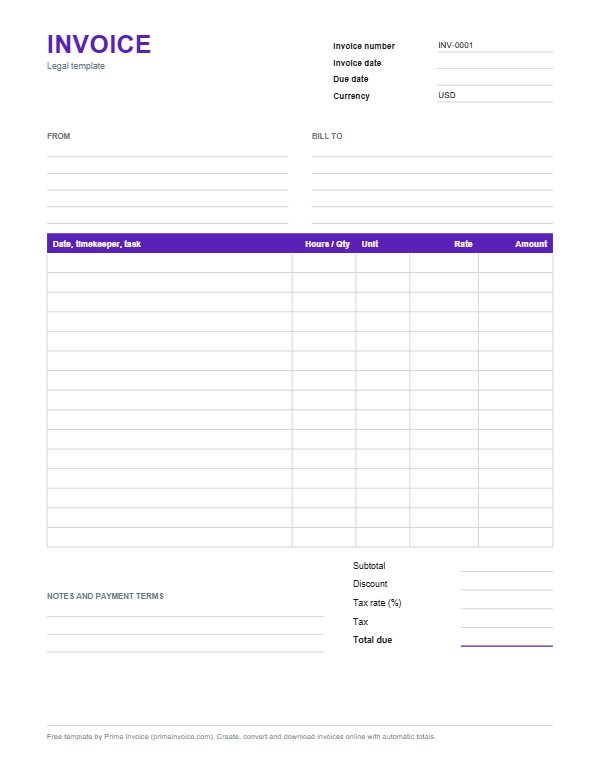
Example legal invoice
These are typical lines for this kind of work. Edit, delete or add lines once the template is open.
| Date, timekeeper, task | Hours / Qty | Unit | Rate | Amount |
|---|---|---|---|---|
| Initial consultation and case assessment (partner) | 1.5 hourat $350.00 | hour | $350.00 | $525.00 |
| Legal research: limitation periods (associate) | 3.2 hourat $225.00 | hour | $225.00 | $720.00 |
| Drafting demand letter (associate) | 2.4 hourat $225.00 | hour | $225.00 | $540.00 |
| Document review and index (paralegal) | 4 hourat $120.00 | hour | $120.00 | $480.00 |
| Contract review package, flat fee | 1 flat feeat $950.00 | flat fee | $950.00 | $950.00 |
| Court filing fee, disbursement at cost | 1 itemat $405.00 | item | $405.00 | $405.00 |
| Courier and certified mail, at cost | 3 itemat $18.50 | item | $18.50 | $55.50 |
| Subtotal before tax | $3,675.50 | |||
Typical columns on a legal invoice
| Column | What to put in it |
|---|---|
| Date, timekeeper and task | Each time entry starts with the date and who did the work, then a clear task description: "12 Oct, JD: drafted response to motion to dismiss". |
| Hours or quantity | Time in the decimal increments your engagement letter states, or the count for flat-fee items and disbursements. |
| Rate | The hourly rate of that timekeeper (partner, associate, paralegal), the flat fee, or the cost of the disbursement. |
| Amount | Hours multiplied by rate, or the flat amount, calculated automatically online and in the Excel version. |
| Matter reference | The client and matter number or name, so the bill files against the right engagement on both sides. |
| Retainer or trust applied | Shown below the lines: funds applied from an advance payment, and the balance remaining or due. |
What clients look for on a legal bill
Clients often feel legal fees are opaque. A clear invoice is one of the few things a firm controls that directly changes that impression. Every line should answer three questions: when was the work done, who did it, and what exactly did they do? "Research" with three hours next to it is hard to accept. "Researched limitation period for breach of contract claims in this jurisdiction" is not.
Group entries by matter, and if a client has several matters, either send one invoice per matter or separate them clearly. Corporate clients frequently allocate legal spend to different cost centres and will return a mixed bill for correction.
Time entries, increments and timekeepers
Hourly matters are billed from time records. State in your engagement letter the increment you bill in, for example six-minute units (0.1 hour), and keep entries to that precision. Record time contemporaneously; reconstructing a week of entries from memory is how both under-billing and disputes happen.
Show each timekeeper's role and rate. Delegating document review to a paralegal at a lower rate is a value point for the client, and the invoice is where they see it. Avoid block billing, where several tasks are lumped into one long entry with a single total time; many clients and some courts reviewing fee applications dislike it because it is hard to assess.
Flat fees, contingency and hybrid arrangements
Fixed-fee services such as wills, incorporations, trademark filings, conveyancing or contract review packages are simple to invoice: one line per service with the agreed price, plus disbursements. Describe what the flat fee included so later add-ons are clearly separate.
Contingency or success fees depend on an outcome and are regulated differently across jurisdictions. Where they are allowed, the invoice should show the recovery amount, the percentage or formula from the signed agreement, and the deductions in the order the agreement specifies. Hybrid arrangements, such as a reduced hourly rate plus a success component, should show both parts clearly.
Disbursements and third-party costs
Disbursements are costs paid on the client's behalf: court and filing fees, process servers, expert witnesses, transcripts, travel, translation, searches and registry fees. List each one separately, marked at cost unless your engagement letter allows a handling charge, and keep receipts available. Large anticipated disbursements, such as an expert's report, are often collected from the client in advance.
Routine office overheads such as normal photocopying, phone calls and research database subscriptions are treated differently by different firms; whatever your policy, write it into the engagement letter so the invoice simply applies it.
Retainers, advance payments and trust funds
Many lawyers take an advance payment before starting work and apply it to invoices as fees are earned. Client money held in advance is often subject to strict trust accounting rules set by your bar, law society or regulator, including separate accounts, records and rules about when funds may be withdrawn. Those rules vary by jurisdiction, so follow your regulator's guidance rather than a template.
On the invoice, show the total of the current bill, the amount applied from funds held, and either the balance due from the client or the remaining credit. A short statement of the funds held keeps the client informed and helps you reconcile your records.
A worked example from the sample lines
The sample shows a mixed bill: 1.5 partner hours at $350 ($525), 3.2 associate research hours at $225 ($720), 2.4 associate drafting hours at $225 ($540), 4 paralegal hours at $120 ($480), a $950 flat-fee contract review, a $405 filing fee and three courier items at $18.50 ($55.50). The subtotal before tax is $3,675.50.
These are illustrative numbers, not suggested rates. Legal rates differ enormously by country, city, practice area and seniority.
Corporate clients and billing guidelines
In-house legal departments often send outside counsel guidelines covering staffing, rates, travel, what can be billed and how invoices must be submitted, sometimes through an e-billing platform using task and activity codes. Read them before the first invoice; non-compliant entries are routinely cut.
Budgets and estimates matter here too. When a matter is approaching its budget, warn the client before the invoice does it for you.
Write-downs, discounts and courtesy credits
Firms sometimes reduce time that was recorded but not worth charging, such as a junior lawyer getting up to speed. Showing a courtesy discount as a visible line, rather than silently deleting entries, communicates goodwill and keeps your records honest about the real effort. Agreed volume discounts for institutional clients can be shown the same way.
Confidentiality on the invoice itself
Invoices travel through accounts departments, auditors and sometimes opposing parties in fee disputes. Describe the work with enough detail to justify the charge but without disclosing privileged advice or sensitive facts. "Telephone conference with client regarding settlement strategy" is usually better than summarising what was said. When in doubt, ask how the client wants sensitive matters described.
Payment terms and collections
State the due date, accepted payment methods and the matter reference to quote with payment. Professional rules in some jurisdictions affect how lawyers may charge interest or pursue fees, so check yours before adding late charges. Prima Invoice lets you add a payment link from your own Stripe or PayPal account; payments go directly to your firm and never through us. If your regulator restricts how client funds are received, keep the payment link for fees only and follow your trust account procedures for advance payments.
Practice-area patterns
Litigation bills follow the phases of a case: pleadings, discovery and disclosure, depositions or witness statements, motions, mediation, trial preparation, hearings and appeals. Labelling each entry with its phase lets the client compare spending against the budget for that stage. Family law matters often mix hourly negotiation and court attendance with fixed fees for uncontested filings. Immigration practices commonly quote fixed fees per petition or visa application, with government charges passed through separately.
Real estate closings and conveyancing are usually flat-fee transactions plus searches, registration duties and wire charges. Estate planning offers packages for wills, powers of attorney and trusts, while probate administration may be hourly or follow a scale where local rules permit. Intellectual property prosecution firms bill per application, office action response or renewal, and criminal defence often uses staged flat fees covering arraignment, pre-trial and trial. Copy the vocabulary your clients already see in their own budgets.
Pro bono, reduced-fee and legal aid work
Where you act without charge or at a reduced rate, consider still issuing a statement that records the time and shows the full value written off. It documents your contribution for internal reporting and makes clear the client was not overlooked. Publicly funded legal aid work follows the paying authority's own claim forms and tariffs, so use their format rather than a private invoice.
Handling a fee query gracefully
When a client challenges a bill, respond quickly, walk through the entries, and separate genuine errors from disagreements about value. Correct mistakes with a credit note or revised invoice rather than editing the original, so your sequence stays intact. Some professional bodies run fee arbitration or complaints schemes; find out whether yours does, because mentioning a neutral route when a disagreement escalates often lowers the temperature. Prevention is cheaper still: periodic billing, budget updates and plain-English narratives reduce surprises that trigger objections months after the work.
Tips for your legal invoice
Who, when, what on every entry
Date, timekeeper and a specific task on each line make hourly bills far easier to approve.
Avoid block billing
Split combined entries into separate tasks with their own time. Clients and reviewers can then assess each one.
Mark disbursements at cost
Third-party costs on their own lines, labelled at cost, keep fees and expenses visibly separate.
Show the retainer balance
After applying funds held, state what remains. Clients appreciate knowing where their advance stands.
Protect privileged detail
Describe tasks precisely without revealing advice or strategy. Invoices are read by more people than the client.
Label litigation phases
Tagging each entry as discovery, motions or trial preparation lets clients track spending against stage budgets.
Frequently asked questions
What should a lawyer's invoice include?
Your firm and client details, the matter reference, an invoice number and date, dated time entries with the timekeeper and task, flat fees, disbursements, any funds applied from a retainer, the total and balance due, and how to pay.
What billing increment do lawyers use?
It varies by firm and is set out in the engagement letter; six-minute units (0.1 hour) are a common choice. Whatever you use, record and bill time consistently in that increment.
How do I show a retainer on a legal invoice?
Show the total of the current invoice, the amount applied from funds held in advance, and the resulting balance due or remaining credit. Follow your regulator's trust accounting rules for the funds themselves.
What are disbursements on a legal bill?
Costs the firm pays on the client's behalf, such as court fees, process servers, expert reports, transcripts, searches and travel. List them separately from professional fees.
Is block billing allowed on legal invoices?
It is not always prohibited, but many clients and fee reviewers dislike it because combined entries are hard to assess. Separate entries per task are the safer practice.
Can a law firm invoice in another currency?
Yes. Choose any ISO 4217 currency in the generator and agree the currency in your engagement letter, especially for international clients.
How should litigation time entries be organised?
Group or label entries by phase, such as pleadings, discovery, motions, mediation and trial preparation, so the client can compare spending against the budget for each stage of the case.
Sources
Sources checked 2026-10-26. Rules differ by country, so check with your local tax office or an adviser.
Related templates
Consulting Invoice Template
Retainer, day-rate and project invoice for consultants and advisers, with workshop, report and reimbursable expense lines.
Freelance Invoice Template
Hourly and project-based invoice for freelancers, with typical lines such as discovery calls, drafts, revisions and rush fees.
Invoice Template for Word
An editable .docx invoice with item table, totals block and payment terms, ready for your logo and prices.
Fill it in online, download a PDF
The invoice generator opens with this template's lines. Add your prices, tax and logo, then download.