
Graphic Design Invoice Template
A graphic design invoice template is a bill that lists the creative work you delivered, from discovery and concepts to revision rounds, final artwork files and the usage rights the client receives. It also carries your studio details, the client, an invoice number, the project name, payment terms and the total. Use it online with typical design lines already filled in, or download it for Excel, Word or as a blank PDF.
Free, no account. Opens the invoice generator with these lines filled in.
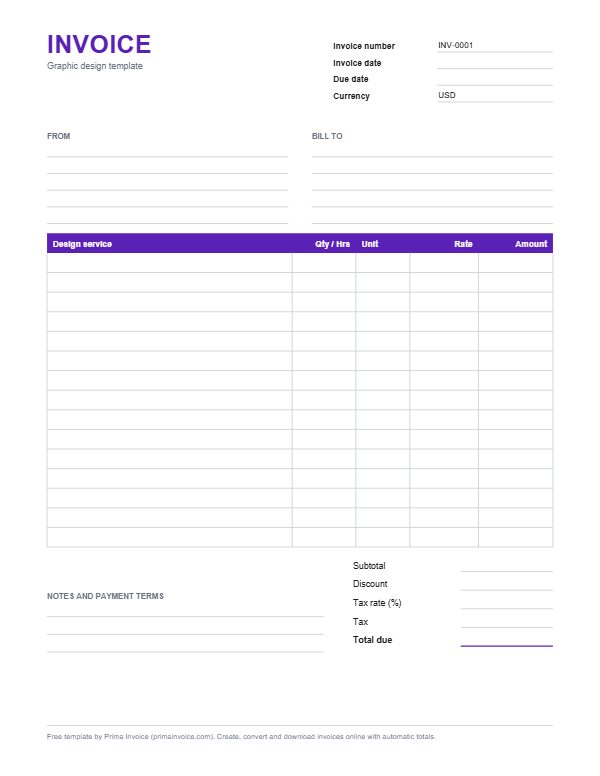
Example graphic design invoice
These are typical lines for this kind of work. Edit, delete or add lines once the template is open.
| Design service | Qty / Hrs | Unit | Rate | Amount |
|---|---|---|---|---|
| Discovery workshop and mood board | 1 sessionat $300.00 | session | $300.00 | $300.00 |
| Logo concepts, three directions | 3 conceptat $250.00 | concept | $250.00 | $750.00 |
| Refinement rounds (two included) | 2 roundat $120.00 | round | $120.00 | $240.00 |
| Extra revision requested after sign-off | 1.5 hourat $80.00 | hour | $80.00 | $120.00 |
| Brand colour palette and type guide | 1 guideat $350.00 | guide | $350.00 | $350.00 |
| Business card design, two sides | 1 layoutat $150.00 | layout | $150.00 | $150.00 |
| Final artwork files (SVG, PDF, PNG) | 1 packageat $100.00 | package | $100.00 | $100.00 |
| Commercial usage licence, worldwide | 1 licenceat $200.00 | licence | $200.00 | $200.00 |
| Subtotal before tax | $2,210.00 | |||
Typical columns on a graphic design invoice
| Column | What to put in it |
|---|---|
| Design service | Name each creative stage or asset: "Logo concepts, three directions", "Business card layout, double sided", "Social media kit, 12 templates". |
| Quantity or hours | Count of concepts, pages, templates or artboards for fixed-price items; hours for open-ended changes. |
| Unit | concept, round, page, artboard, hour, licence. It shows whether a price was per item or per hour. |
| Rate | Your agreed price per unit. Package prices go in as quantity 1 with the full fee. |
| Amount | Quantity times rate, calculated for you online and in the Excel version. |
| Usage rights | A licence or rights line that states where, how long and for what the client may use the work. Often the most important line on a design bill. |
What a design client expects to see
Design buyers range from a café owner commissioning a first logo to a marketing department ordering campaign assets. Both want the same thing from the bill: recognisable deliverables, a sense of how much effort each stage took, and certainty about what they are now allowed to do with the artwork. A design invoice that lists "Branding, $1,800" answers none of those questions.
Break the project into the stages your proposal described. Discovery, concepts, refinements, final files and rights are the usual building blocks, and each one can be a line. If you sold a package price, keep it as one line but name what the package contained in the description.
Concepts, revision rounds and scope creep
Revisions are where design projects lose money. The fix starts in your proposal: state how many concepts you will present and how many refinement rounds are included. On the invoice, show the included rounds with the agreed price and any further changes as a separate hourly line marked "requested after sign-off" or "beyond included rounds".
This makes extra work visible without sounding like a penalty. Clients usually accept the charge when they can see that they asked for a fourth round of colour tweaks after approving the third.
When a client changes direction completely, for example rejecting all concepts and briefing a new style, treat it as a new phase. Invoice the completed concept stage and quote the new direction separately.
Usage rights and licensing on the invoice
Copyright is the part of design billing that many new designers skip. In the United States, the Copyright Office explains that a work is under copyright protection the moment it is created and fixed in a tangible form. That means you, as the creator, usually own the artwork until something says otherwise.
A transfer of copyright ownership under US law is not valid unless it is in writing and signed by the owner of the rights. An invoice line that says "usage licence" is a commercial record, but the actual terms of a licence or assignment belong in a signed agreement. Many designers grant a licence for specific uses and charge more for a full buyout of rights. Others assign copyright once the final invoice is paid in full. Rules differ between countries, so ask a lawyer where you work before you rely on a template clause.
On the invoice, name the rights in plain words: "Commercial usage licence, worldwide, perpetual, excludes resale of the artwork". The client's lawyer and your future self will both thank you.
Print, production and third-party costs
Print jobs bring outside costs: proofs, paper upgrades, special finishes, delivery. If you manage printing for the client, list the printer's charge as its own line and say whether you add a handling fee. Keep the printer's invoice in case the client asks.
Stock images, licensed fonts, mock-up files and plug-ins bought specifically for a project can be passed through too. Fonts are a frequent surprise: a typeface licensed to you may not cover the client's own use, so check the foundry's licence and bill a client licence when the brand will be used by their staff.
Software subscriptions you use for every client are overheads and normally belong in your rate, not on individual invoices.
Deposits and kill fees
A deposit of a third or a half before concepts begin is common for freelance designers and small studios. Invoice it on its own, then show it as a payment on the final invoice so the balance is clear.
A kill fee protects you when a client cancels midway. Define it in the proposal, for example "If the project is cancelled after concepts are presented, 50% of the total fee is payable". If you ever need to invoice it, quote that clause in the line description.
A worked example from the sample lines
The sample is a small identity project. A $300 discovery workshop, three logo concepts at $250 ($750), two included refinement rounds at $120 ($240), an hour and a half of extra revisions at $80 ($120), a $350 palette and type guide, a $150 business card layout, a $100 final files package and a $200 commercial licence. The subtotal before tax is $2,210.
These numbers demonstrate structure, not market rates. Design fees depend on experience, client size and location.
Retainers for ongoing design support
Once a brand launches, many clients need a steady flow of social graphics, presentation slides, banners and email headers. A monthly design retainer with a set number of hours or assets is easier to budget for both sides than ad-hoc invoices. Bill the retainer at the start of each month, list any overflow work separately, and consider a recurring invoice so it goes out on the same day every month.
Track requests in a shared list so the client can see how much of the allowance is used. It turns the monthly bill into a formality.
Handing over files and getting paid
Some designers send final high-resolution files only after the last payment clears, sharing watermarked or low-resolution proofs before then. If you work that way, write it in your terms and add a line to the invoice notes: "Final files released on receipt of payment". It is a gentle, effective incentive.
Include a payment link from your own Stripe or PayPal account so the client can pay by card in a minute. Funds go to your account directly.
Agency and white-label work
Designers who work behind an agency bill the agency, not the end brand. Use the agency's job number, the account manager's name and their billing contact. Agencies often pay on their own cycle, after their client pays them, so confirm the timing in your agreement and do not assume the end client's terms apply to you.
If you design under someone else's name, check whether your contract allows you to show the work in your portfolio. That permission is separate from payment and worth writing down.
Pricing changes and rate reviews
Review your rates once a year and tell regular clients a month before a change takes effect. Show the new rate on the next quote rather than surprising anyone on an invoice. Long-standing clients appreciate notice; new ones simply see your current price.
Lines for web, motion, packaging and illustration work
The sample covers an identity project, but the same structure stretches to other disciplines. Web and UI designers typically bill wireframes, high-fidelity screens, a clickable prototype, a component library and developer handoff. Motion designers itemise storyboards, animatics, seconds of finished animation and render passes. Packaging specialists list dielines, structural mock-ups, label artwork per SKU and press checks. Illustrators charge per spot illustration, full-page piece or cover, and price exclusivity separately.
Whatever the discipline, keep the unit honest: screens, seconds, SKUs, spreads or pieces are far clearer to a buyer than an unexplained lump. A packaging client comparing quotes can then see instantly that your price for six flavour variants is per variant, not per range.
Technical specifications worth noting
Production details prevent expensive misunderstandings at the printer. Note colour mode (CMYK for press, RGB for screens), bleed and trim, resolution, spot colours and the file types supplied. If you delivered editable source files, say so; many designers charge extra for layered originals because they let the client produce future work without you.
For digital deliverables, mention responsive breakpoints, retina exports, accessibility contrast checks or animation frame rates where relevant. These descriptions double as a delivery checklist, and they make any later dispute about what was handed over short and factual.
Pitches, spec work and unpaid tests
Prospective clients sometimes ask several studios for free sample designs before choosing one. Plenty of designers decline speculative work outright, while others charge a modest paid pitch fee. If you agree to a paid pitch, invoice it immediately with a description such as "Pitch fee, two initial sketches, non-exclusive", so ownership of unused sketches stays unambiguous and the fee is settled whether or not you win the contract.
Tips for your graphic design invoice
Name deliverables, not tools
Clients pay for a logo system or an event poster, not for hours in a design app. Describe outcomes the client recognises.
Keep included and extra rounds apart
Two lines, one for included refinements and one for extra changes, make scope creep visible without an argument.
Put rights on their own line
A dedicated licence line documents what the client bought and makes a later upgrade, such as broadcast use, easy to price.
Release finals after payment
Share proofs first and send production files once the invoice is paid. Say so in your terms and the invoice notes.
Show deposits as payments
Record the deposit on the final invoice so the client sees the full project value, what was paid and what remains.
Number your invoices per studio, not per client
One continuous sequence across every client keeps bookkeeping simple and avoids duplicate numbers when two clients start the same week.
Frequently asked questions
How do I charge for extra revisions on a design invoice?
Show the included revision rounds at the agreed price, then add a separate hourly line for changes requested beyond them. Describe it neutrally, for example "Additional changes requested after sign-off, 1.5 hours".
Should a graphic design invoice include copyright or usage rights?
It should name the rights the client is paying for, such as a commercial usage licence, while the full licence or assignment terms belong in a signed agreement. Under US law a transfer of copyright ownership must be in writing and signed.
Is it normal to ask for a deposit before starting design work?
Yes. Many designers invoice a third to a half of the fee before concept work begins and show it as a payment on the final invoice.
Can I bill the client for stock photos and fonts?
Yes, when they were bought for that client's project. List them as separate lines, state whether they are at cost, and check that the licence covers the client's intended use.
What is a kill fee on a design project?
A kill fee is an amount the client pays if they cancel the project partway through. It should be defined in your proposal or contract, and the invoice should quote that clause.
How do I invoice a logo package with a fixed price?
Use one line with quantity 1 and the package price, and spell out what it included in the description, such as three concepts, two refinement rounds and final files in vector and raster formats.
Should I charge extra for editable source files?
Many designers do, because layered originals let the client create new material without hiring you again. Decide your policy, state it in your proposal, and add a separate line when source files are part of the handover.
Sources
- U.S. Copyright Office: Copyright in General (FAQ)
- 17 U.S. Code 204: Execution of transfers of copyright ownership
- GOV.UK: Invoices, what they must include
Sources checked 2026-10-25. Rules differ by country, so check with your local tax office or an adviser.
Related templates
Photography Invoice Template
Invoice for portrait, event, product and commercial shoots, with session, retouching, licence, travel and print lines.
Freelance Invoice Template
Hourly and project-based invoice for freelancers, with typical lines such as discovery calls, drafts, revisions and rush fees.
Free Quote Template
Fixed-price quotation with scope, line items, valid-until date and acceptance terms, convertible into an invoice.
Fill it in online, download a PDF
The invoice generator opens with this template's lines. Add your prices, tax and logo, then download.