
Photography Invoice Template
A photography invoice template is a bill for a shoot that lists the session fee, post-production, the number of edited images delivered, the licence that says how the client may use them, and costs such as travel, assistants, studio hire or prints. It also shows your business details, the client, the shoot date, an invoice number and the payment terms. Open it online with typical photography lines filled in, or download it for Excel, Word or as a blank PDF.
Free, no account. Opens the invoice generator with these lines filled in.
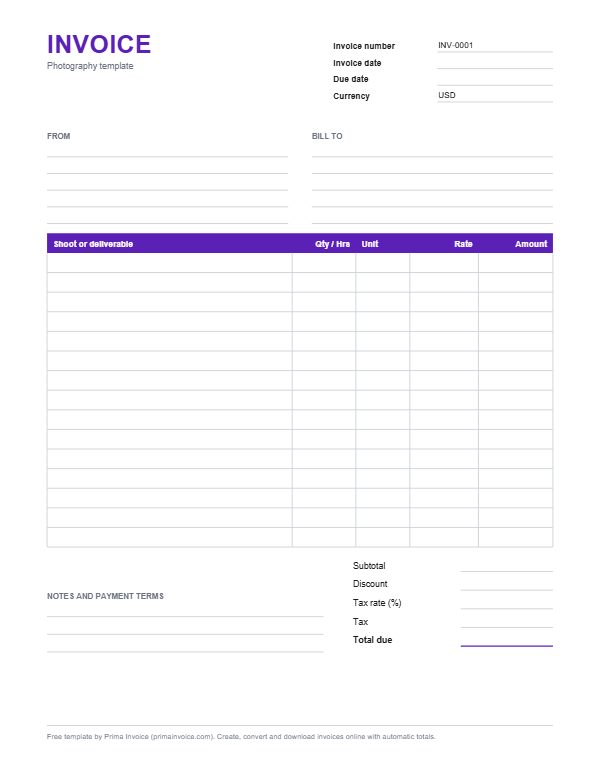
Example photography invoice
These are typical lines for this kind of work. Edit, delete or add lines once the template is open.
| Shoot or deliverable | Qty / Hrs | Unit | Rate | Amount |
|---|---|---|---|---|
| Commercial shoot, half day on location | 1 half dayat $950.00 | half day | $950.00 | $950.00 |
| Photo assistant | 4 hourat $45.00 | hour | $45.00 | $180.00 |
| Lighting and grip equipment hire | 1 dayat $180.00 | day | $180.00 | $180.00 |
| Selection gallery and client review | 1 galleryat $75.00 | gallery | $75.00 | $75.00 |
| Retouched images, high resolution | 25 imageat $35.00 | image | $35.00 | $875.00 |
| Usage licence: web and social, 2 years, non-exclusive | 1 licenceat $600.00 | licence | $600.00 | $600.00 |
| Travel, round trip to location | 84 mileat $0.70 | mile | $0.70 | $58.80 |
| Fine art print, 16 x 20 inch | 2 printat $85.00 | $85.00 | $170.00 | |
| Subtotal before tax | $3,088.80 | |||
Typical columns on a photography invoice
| Column | What to put in it |
|---|---|
| Shoot or deliverable | Describe each element: "Half-day product shoot, studio", "Retouched images, high resolution", "Second shooter". |
| Quantity or hours | Hours of coverage, number of final images, number of prints or days of hire. |
| Unit | hour, half day, image, print, day, licence. Event clients in particular want to know if coverage was billed hourly or as a package. |
| Rate | Price per unit as quoted. Package prices go in as one line with quantity 1. |
| Amount | Quantity multiplied by rate, added up automatically online and in the spreadsheet. |
| Licence terms | Scope of use (web, print, advertising), territory, duration and exclusivity. For commercial work this line often carries most of the value. |
Creative fee, production costs and the licence
Professional photographers usually separate three kinds of charge. The creative or session fee pays for your time and expertise on the day. Production costs cover assistants, equipment, studio rental, props, styling, hair and make-up, location permits and travel. The licence fee prices the client's right to use the pictures. Keeping those groups apart makes your bill easy to compare with the estimate the client approved and stops anyone treating your licence fee as optional padding.
Consumer work such as family portraits or weddings often bundles everything into packages instead. That is fine; just name what the package contains, especially the number of edited images and any albums or prints.
Copyright and image licensing
Under US law, as the Copyright Office explains, a photograph is under copyright protection the moment it is created and fixed in a tangible form. Unless you are an employee or sign the rights away, the photographer typically starts as the owner. Clients therefore pay for permission to use the images, not for the images themselves.
A licence line should cover the media (website, social channels, print brochure, billboard, packaging), the territory, the time period and whether the licence is exclusive. A transfer of copyright ownership in the US is only valid when it is in writing and signed, so if a client insists on a full buyout, use a signed agreement and price it accordingly. Laws vary between countries; when a big commercial licence is involved, a short consultation with a lawyer is money well spent.
Model and property releases are separate documents again. Mention on the invoice whether releases were obtained, because they decide whether the client can use recognisable people or private buildings in advertising.
Retouching, culling and delivery
Post-production is real work that clients rarely see. Culling hundreds of frames to a shortlist, colour grading, skin retouching, compositing and exporting in several sizes can take longer than the shoot. Quote and invoice it explicitly, either per final image or per hour of editing, and state the delivery format: online gallery, download link, or drive.
Advanced retouching such as background replacement or product clipping paths deserves its own line at a higher rate than basic colour correction. Clients ordering hundreds of catalogue images especially appreciate seeing that difference.
Events, weddings and hourly coverage
Event photography is usually priced by hours of coverage with a minimum booking. If the event runs late and the client asks you to stay, add an overtime line at the agreed hourly rate and note who approved it on the night. Second shooters, travel beyond a set radius and overnight accommodation for distant venues are common extras.
For weddings and large private events, a booking retainer secures the date. Invoice it when the contract is signed, then show it as a payment on the final balance invoice, which many photographers send a few weeks before the event.
Product and e-commerce photography
Online shops order images in volume: a white-background hero shot, angles, close-ups and a lifestyle frame per item. Price per product or per final image, and list the quantity of SKUs and the variants photographed. Mention who handled sample shipping and returns, because couriers and insurance for valuable items are real costs that belong on the bill.
Batch discounts for large catalogues are best shown as a visible discount on the invoice so your standard per-image price stays clear for future orders.
Prints, albums and physical products
Portrait and wedding photographers often sell prints, canvases and albums after the shoot. Each product should be its own line with its size, finish and quantity. If your lab ships directly to the customer, add the shipping cost. Sales tax or VAT on physical goods can work differently from tax on services in some places, which is another reason to keep products separate from the session fee.
A worked example from the sample lines
The sample describes a half-day commercial job: a $950 location shoot, four assistant hours at $45 ($180), $180 of equipment hire, a $75 selection gallery, 25 retouched images at $35 ($875), a $600 two-year web and social licence, 84 travel miles at $0.70 ($58.80) and two 16 by 20 inch prints at $85 ($170). The subtotal before tax is $3,088.80.
The prices are illustrative only. Photography rates depend heavily on genre, market and usage, and commercial licences in particular vary with the size of the campaign.
Cancellations, reschedules and weather
Outdoor shoots depend on light and weather, and events can be postponed. Spell out in your booking terms what happens to the retainer if the client cancels, how many reschedules are free, and what fee applies to a late cancellation that leaves you unable to rebook the slot. If you ever invoice a cancellation fee, quote the relevant clause and the dates involved.
Getting paid before handing over the gallery
A practical safeguard is to share a watermarked proofing gallery straight after the shoot and release full-resolution downloads once the balance is paid. Add a note to the invoice saying so. With a payment link from your own Stripe or PayPal account in the PDF, most clients settle the same day the gallery link arrives.
Prima Invoice never holds the money; the payment goes straight to your account. If you prefer, list bank details instead.
Archiving and re-licensing
Keep invoices together with the shoot folders and the licence terms. When a client comes back a year later wanting to use an image in a print campaign, the original invoice tells you exactly what they already licensed, and you can invoice the extension as a new licence line rather than renegotiating from scratch.
Genre-specific lines photographers add
Real estate photographers commonly price per property by square footage band, then add twilight exteriors, aerial views, floor plans and virtual tours as extras. Corporate headshot sessions are often billed per person with a setup fee for an on-site mini studio. Food photographers bring in a food stylist, prop rentals and sometimes a test kitchen, each worth a separate line because they are booked independently.
Fashion and lookbook work adds models, agency booking fees, wardrobe stylists and fitting time. Sports and school photographers frequently invoice an organisation for coverage while selling prints to parents directly. Architectural shoots may need tilt-shift lenses, permits for public spaces and early-morning call times. Whatever your niche, borrow the vocabulary your buyers already use; a marketing manager instantly understands "hero image", "cut-out" and "lifestyle frame".
Video add-ons and hybrid packages
Many shooters now offer short clips alongside stills: reels, behind-the-scenes footage, cinemagraphs. Bill video separately with its own deliverable count and running time, plus editing, captions, colour correction and music licensing. Stock soundtracks carry their own terms, so confirm the track licence covers the client's platforms before passing the cost through.
Equipment, insurance and backups
Your cameras, lenses, memory cards, liability cover and redundant storage are business overheads priced into your rates, not invoice lines. The exceptions are rentals made specifically for one assignment, such as a cinema lens, a medium-format body or a generator for a remote location, which are reasonable to itemise. Venues sometimes demand proof of public liability insurance before admitting vendors; keep the certificate handy, and if a venue charges a vendor or access fee, pass it through transparently.
Tips for your photography invoice
Write the shoot date on every invoice
Put the session or event date in the notes. It ties the bill to the job, the licence start date and the model releases.
Spell out the licence scope
Media, territory, duration and exclusivity in one line prevents a client from quietly using web images on a billboard.
Separate editing from shooting
Post-production is often half the effort. A separate retouching line explains the price of edited images.
Release full files after payment
Watermarked proofs first, high-resolution downloads once paid. Say so in your terms and invoice notes.
Bill travel in a clear unit
Per mile, per kilometre or a flat zone fee, agreed in advance. Avoid an unexplained "travel" lump sum.
Quote the gallery expiry
If download links expire after a set number of days, state the date in the invoice notes so clients save their images in time.
Frequently asked questions
What is the difference between a session fee and a licence fee?
The session or creative fee pays for your time and skill on the shoot. The licence fee pays for the client's right to use the images in particular media, territories and time periods. Commercial clients usually see both on the invoice.
Does a client own the photos once they pay the invoice?
Not automatically. In the US, copyright usually stays with the photographer unless ownership is transferred in a signed written agreement. Paying the invoice normally gives the client the licence described on it.
How do I invoice extra hours at an event?
Add an overtime line with the number of extra hours, your agreed overtime rate and a short note on who approved it on the day.
Should prints and albums be on the same invoice as the shoot?
You can include them, but put each product on its own line with size, finish and quantity. Some photographers send a separate product invoice after the client chooses images.
How much should a photography booking retainer be?
There is no fixed rule; many photographers ask for a portion of the total to secure the date. Whatever you choose, state it in your contract and show it as a payment on the final invoice.
Can I charge a client for using my photos beyond the original licence?
Yes, if they need wider use, such as print advertising after a web-only licence. Invoice a licence extension as a new line that states the added media, territory and period.
How do real estate photographers usually invoice?
Typically per property, often by size band, with extras such as twilight exteriors, aerial images, floor plans or virtual tours on separate lines. The agent or brokerage is usually the client, with the listing address in the notes.
Sources
- U.S. Copyright Office: Copyright in General (FAQ)
- 17 U.S. Code 204: Execution of transfers of copyright ownership
- GOV.UK: Invoices, what they must include
Sources checked 2026-10-25. Rules differ by country, so check with your local tax office or an adviser.
Related templates
Graphic Design Invoice Template
Invoice for logo, brand and print design work, with concept, revision, artwork, licence and rush lines.
Freelance Invoice Template
Hourly and project-based invoice for freelancers, with typical lines such as discovery calls, drafts, revisions and rush fees.
Free Receipt Template
Proof-of-payment template with payment date, method, items, amount paid and balance, in Word, Excel and PDF.
Fill it in online, download a PDF
The invoice generator opens with this template's lines. Add your prices, tax and logo, then download.