
Construction Invoice Template
A construction invoice template is a bill for building work that shows what has been completed in this billing period against the agreed contract: the stages or schedule of values, the percentage finished, approved change orders, materials stored or installed, retainage held back, previous payments and the amount due now. It also lists the contractor, the owner or general contractor, the project and site address, the invoice number and the payment terms. Open it online with typical construction lines filled in, or download it for Excel, Word or as a blank PDF.
Free, no account. Opens the invoice generator with these lines filled in.
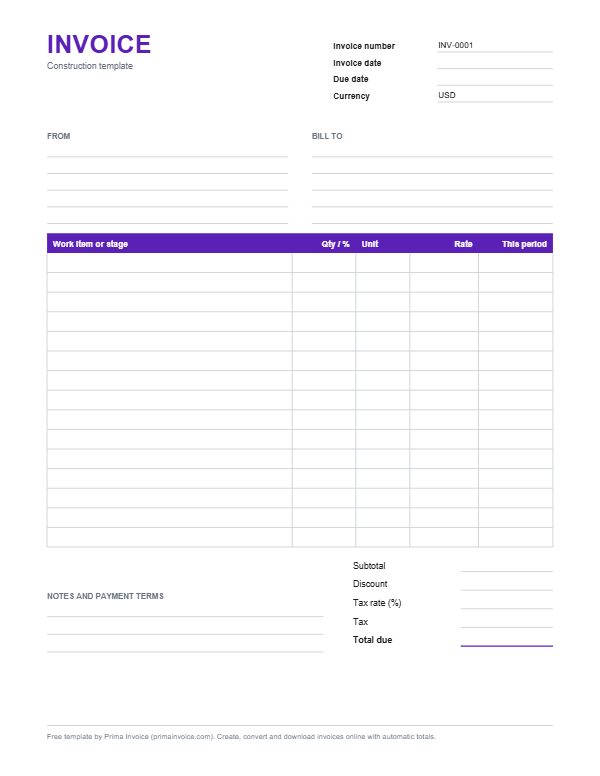
Example construction invoice
These are typical lines for this kind of work. Edit, delete or add lines once the template is open.
| Work item or stage | Qty / % | Unit | Rate | This period |
|---|---|---|---|---|
| Site preparation and excavation (100% complete) | 1 stageat $12,500.00 | stage | $12,500.00 | $12,500.00 |
| Concrete foundations and slab (60% of $38,000) | 0.6 stageat $38,000.00 | stage | $38,000.00 | $22,800.00 |
| Structural steel delivered and stored on site | 1 lotat $14,750.00 | lot | $14,750.00 | $14,750.00 |
| Framing labor, crew of four | 160 hourat $65.00 | hour | $65.00 | $10,400.00 |
| Change order 03: additional drainage run | 1 COat $4,180.00 | CO | $4,180.00 | $4,180.00 |
| Equipment rental: excavator, 5 days | 5 dayat $450.00 | day | $450.00 | $2,250.00 |
| Waste removal, 20 yard dumpster swaps | 3 swapat $525.00 | swap | $525.00 | $1,575.00 |
| Subtotal before tax | $68,455.00 | |||
Typical columns on a construction invoice
| Column | What to put in it |
|---|---|
| Work item or stage | Use the same item names and order as the contract's schedule of values: "Foundations", "Framing", "Roof covering", "Electrical rough-in". |
| Quantity or percent | Units installed this period, or the share of a stage completed, such as 0.4 for 40% of a lump-sum item. |
| Rate | Contract value of the item, or the unit rate for measured work such as cubic yards of concrete or square feet of drywall. |
| This period | The amount billed now for that item, quantity multiplied by rate, calculated automatically. |
| Change order number | Each approved variation gets its own line that quotes the change order or variation number and the date it was signed. |
| Retainage and previous payments | Shown below the lines so the owner can see the gross value of work, the amount withheld and the net payment due. |
Why construction uses progress invoices
Building projects run for weeks or months and tie up large sums in labour and materials long before handover. Instead of one final bill, contractors usually invoice at agreed intervals, often monthly or at defined milestones, for the value of work completed so far. Owners, lenders and general contractors are used to this rhythm, and many contracts require it.
Each progress invoice should be easy to reconcile with the previous one. Use the same line items in the same order, carry forward what was billed before, and show only the new value earned in this period. The sample shows a typical mid-project bill: one stage complete, another partly finished, materials stored, labour hours, an approved change order and site costs.
Schedule of values and percent complete
A schedule of values breaks the contract sum into trade or stage items that add up to the total contract price. On each invoice you report how much of every item is finished. For lump-sum items, that is a percentage: 60% of a $38,000 slab is $22,800. For measured items, it is the quantity installed times the unit rate.
Be realistic with percentages. Over-billing early, sometimes called front-loading, may help cash flow briefly but erodes trust with owners and inspectors, and lenders often send someone to verify progress before releasing draws. A site photo log attached to each invoice is the simplest evidence of progress.
Retainage: money held back until completion
Many construction contracts let the owner retain a percentage of each progress payment until the project is complete and defects are fixed. That retained amount, called retainage or retention, is released with the final invoice or after a defects period. On US federal construction contracts, the Federal Acquisition Regulation says a percentage of a progress payment may be retained when satisfactory progress has not been achieved, and that retainage should not be used as a substitute for good contract management.
Private contracts set their own retainage rules, and some states and countries limit the percentage or the release timing. Read your contract, then show retainage clearly on every invoice: gross value of work this period, retainage withheld, and net amount due. Track total retainage held to date so the final release invoice is straightforward. In Prima Invoice you can enter retainage as a negative adjustment in the notes or as a discount line with a clear label.
Change orders and variations
Owners change their minds, ground conditions surprise everyone, and design gaps appear. Any work outside the original scope should be priced and approved in writing as a change order (in some countries called a variation) before it is carried out. Bill each approved change order on its own line that quotes its number, a short description and the approved value.
Never fold extra work into an existing line or bill it without signed approval. Unapproved change orders are the most common source of construction payment disputes, and many contracts state that unapproved extras will not be paid at all.
Materials: installed, stored and delivered
Contracts often allow you to bill for materials delivered and securely stored on site, or sometimes off site in a bonded warehouse, before they are installed. Owners may require proof of ownership, insurance and secure storage. Label these lines clearly, as in the sample's structural steel, so they are not mistaken for completed work.
Large purchased items such as windows, HVAC units or lift equipment can be billed on delivery if your contract allows it. Keep delivery tickets and supplier invoices ready to attach.
Lien waivers and payment paperwork
In parts of the United States and elsewhere, contractors, subcontractors and suppliers can register a lien against a property when they are not paid. Owners and lenders therefore often ask for lien waivers or releases with each payment application, conditional on receiving payment. The forms and rules vary by state and country, so use the ones your contract or jurisdiction requires and keep copies with each invoice.
Other documents that commonly travel with a construction invoice include certificates of insurance, inspection sign-offs, subcontractor payment confirmations and the updated schedule of values. Send them as one package to avoid back-and-forth.
Labour, equipment and site costs
Time-and-materials contracts, and the time-based parts of fixed-price ones, bill labour by the hour or day per worker or crew. State the crew size, trade and dates in the description. Equipment hire such as excavators, scaffolding, cranes, generators or concrete pumps should show the rental period and unit.
General conditions, the costs of running the site such as temporary fencing, site toilets, dumpsters, site supervision and temporary power, are sometimes billed monthly as their own line and sometimes built into the stage prices. Follow the structure in your contract.
A worked example from the sample lines
The sample bills $12,500 for completed site preparation, 60% of a $38,000 slab ($22,800), $14,750 of stored steel, 160 framing hours at $65 ($10,400), change order 03 for $4,180, five excavator days at $450 ($2,250) and three dumpster swaps at $525 ($1,575). The gross value of work this period is $68,455 before tax and retainage.
If the contract withholds 5% retainage, the net due for this period would be the gross amount less 5%, before any tax. The numbers are illustrations only; your contract, location and market set the real figures.
Subcontractors billing a general contractor
Subcontractors usually submit invoices to the general contractor on a schedule tied to the GC's own billing to the owner, often a few days before the GC's cut-off. Late submissions can slip a whole month. Ask for the cut-off date and the GC's preferred format at the start, and include their job number, cost code and the subcontract number.
Many subcontracts contain pay-when-paid or pay-if-paid clauses that link your payment to the owner paying the GC. Their enforceability varies by jurisdiction; know what you signed before the first invoice goes out.
Final invoice and retainage release
At practical completion, issue a final invoice for the remaining contract value, closing out every line of the schedule of values. Retainage is often released in a separate invoice once punch-list items are fixed and any defects liability period ends. Include the documents the owner needs to close the project, such as warranties, as-built drawings, operation manuals and final lien releases where required.
Taxes and local rules
How building work is taxed differs widely between countries, and sometimes between labour and materials or between main contractors and subcontractors. Prima Invoice never adds a rate for you. Enter the tax label and rate that your accountant confirms, and add any required wording to the notes.
Measured work and the units trades use
Unit-rate contracts pay for quantities actually installed, so the units must be unambiguous. Concrete is usually measured in cubic yards or cubic metres, rebar by weight in tons or tonnes, excavation by volume or truckloads, drywall and plastering by square foot or square metre, skirting and trim by linear foot or metre, roofing by the square (one hundred square feet) or by area, and pipework or ductwork by length with fittings counted separately. Brickwork may be priced per thousand bricks or per square metre of wall.
Write the measurement basis into each description, for instance "Blockwork, 140 mm, 86 m2 laid this period", and keep the takeoff sheets or site measurements that support it. Quantity surveyors and cost consultants who check payment applications will ask for them, and a clean measurement record shortens their review dramatically.
Home renovations versus commercial projects
A kitchen remodel or loft conversion for a homeowner rarely needs the full formality of payment applications. Homeowners prefer plain milestones: deposit, demolition and first fix, plastering, second fix and finishes, completion. Keep the vocabulary friendly and attach photos. Commercial, institutional and public projects, by contrast, often require standard payment application forms, certified progress, signed continuation sheets, insurance certificates and sometimes certified payroll reports. Match the level of paperwork to the client, but keep the same numbering discipline and sequence for both.
Delays, weather and disputed valuations
Rain days, late deliveries, design queries awaiting answers and access restrictions all affect what you can bill. If the owner causes delay, your contract may entitle you to an extension of time or prolongation costs; claim them through the contract mechanism, with diaries and correspondence, rather than adding unexplained amounts to a routine invoice.
When an architect, engineer or employer's agent values your application lower than you claimed, ask for their breakdown, agree the undisputed part so it is paid on time, and resolve the remainder separately. Splitting disputed amounts into their own lines on the next application keeps the conversation focused on specifics instead of the whole bill. Adjudication, mediation and arbitration routes differ by jurisdiction, so involve an adviser early if sums are significant.
Tips for your construction invoice
Mirror the schedule of values
Same items, same order, same names on every progress invoice. Reviewers can then compare month to month without a spreadsheet.
Bill change orders separately
One line per approved change order with its number and signed value. Never bury extras in existing lines.
Show retainage on every bill
Gross value, retainage withheld and net due, plus total retainage held to date, keep the final release simple.
Attach progress photos
Dated site photos are the fastest evidence for percent complete when an owner, lender or inspector checks a draw.
Know the cut-off date
Submit before the GC's or lender's billing cut-off. Missing it by a day can delay payment by a month.
Keep a daily site diary
Weather, headcount, deliveries, visitors and instructions recorded each day are your best support for valuations, delay claims and disputed hours.
Frequently asked questions
What is progress billing in construction?
Progress billing means invoicing at regular intervals or milestones for the value of work completed so far, rather than one bill at the end. Each invoice shows the work done this period, previous billing, retainage and the amount due now.
How do I show retainage on a construction invoice?
Show the gross value of work for the period, then the retainage withheld as a separate figure, then the net amount due. Keep a running total of retainage held so you can invoice its release at completion.
How should change orders appear on an invoice?
Each approved change order should be its own line quoting the change order number, a short description and the approved amount. Only bill change orders that were approved in writing.
Can I invoice for materials that are not installed yet?
Often yes, if your contract allows billing for materials delivered and stored. Label them clearly and be ready to show delivery tickets, insurance and secure storage.
What is a schedule of values?
It is a breakdown of the contract sum into stages or trade items that add up to the total price. Progress invoices report the percentage or quantity completed for each item.
Do I need to send lien waivers with my invoice?
Many owners and lenders require lien waivers or releases with payment applications, especially in the United States. The forms and rules depend on the state or country, so follow your contract and local law.
How do I invoice a homeowner renovation in stages?
Agree milestones in the contract, such as demolition, first fix, plastering and completion, and send one invoice per milestone that names the stage, the agreed amount and any approved extras.
Sources
- FAR 32.103: Progress payments under construction contracts (eCFR)
- GOV.UK: Invoices, what they must include
Sources checked 2026-10-25. Rules differ by country, so check with your local tax office or an adviser.
Related templates
Contractor Invoice Template
Labor and materials invoice for plumbers, electricians, handymen and other trades, with call-out, parts and disposal lines.
Free Estimate Template
Cost forecast with labour, materials, allowances, assumptions and a may-change note, convertible into an invoice.
Landscaping Invoice Template
Lawn care and landscaping invoice with mowing, cleanup, mulch, planting, irrigation and green waste lines.
Fill it in online, download a PDF
The invoice generator opens with this template's lines. Add your prices, tax and logo, then download.