
Free Estimate Template
An estimate template is a ready-made document for giving a customer your best forecast of what a job will cost before you start, when some details are still uncertain. It shows your business and the customer, an estimate number and date, a valid-until date, the expected labour, materials and other costs line by line, the estimated total, and the assumptions behind it, with a clear note that the final amount may change. Download it free for Excel, Word or as a blank PDF, or open it in the estimate maker and convert it into an invoice when the work is done.
Free, no account. Opens the estimate maker with these lines filled in.
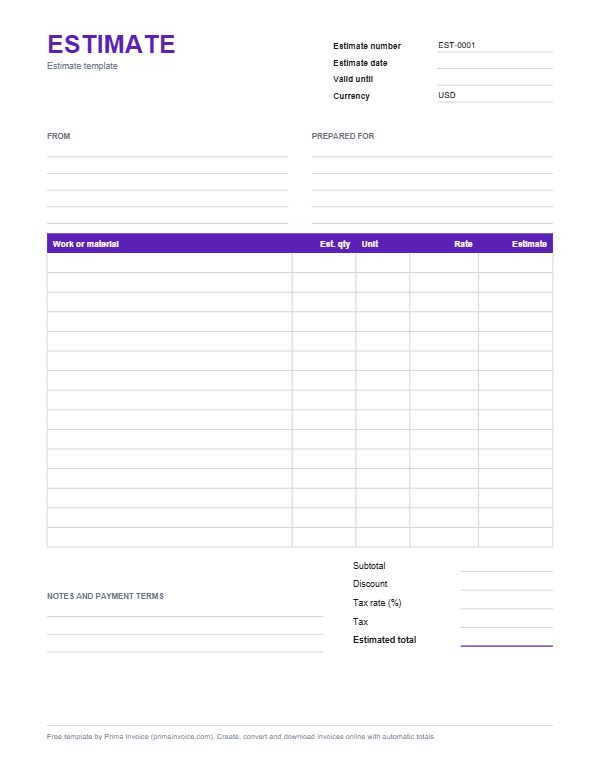
Example estimate
These are typical lines for this kind of work. Edit, delete or add lines once the template is open.
| Work or material | Est. qty | Unit | Rate | Estimate |
|---|---|---|---|---|
| Remove old bathroom fixtures and tiles | 10 hourat $60.00 | hour | $60.00 | $600.00 |
| Plumbing rough-in for new vanity and shower | 8 hourat $95.00 | hour | $95.00 | $760.00 |
| Waterproofing membrane, shower area | 60 sq ftat $4.50 | sq ft | $4.50 | $270.00 |
| Tile allowance, client to choose (up to $8/sq ft) | 120 sq ftat $8.00 | sq ft | $8.00 | $960.00 |
| Tiling labour, floor and shower walls | 120 sq ftat $12.00 | sq ft | $12.00 | $1,440.00 |
| Vanity, toilet and shower fixtures (allowance) | 1 allowanceat $1,800.00 | allowance | $1,800.00 | $1,800.00 |
| Contingency for hidden water damage | 1 contingencyat $750.00 | contingency | $750.00 | $750.00 |
| Subtotal before tax | $6,580.00 | |||
Typical columns on an estimate
| Column | What to put in it |
|---|---|
| Work or material | Each expected task or item, written the way you will later invoice it, so the comparison is easy. |
| Estimated quantity | Your best forecast of hours, units or area. Being explicit about it is what makes an estimate honest. |
| Rate | Your hourly rate or unit price, which normally stays fixed even when quantities change. |
| Estimate | Estimated quantity times rate, totalled into the estimated job cost. |
| Allowances | Placeholder sums for items not yet chosen, such as tiles at up to a stated price per square foot. |
| Assumptions and note | What the figure depends on and the statement that the final amount may change. The estimate maker adds that note automatically. |
When to send an estimate instead of a quote
An estimate is the honest choice when you cannot know the full scope yet. New Zealand's consumer protection guidance describes an estimate as the provider's best guess of what the job will cost, based on skill and past experience, and says plainly that an estimate is not a fixed price. A quote, by contrast, is generally a confirmed maximum price.
Renovations, repairs where the fault is hidden, open-ended creative or software projects, and anything that depends on choices the customer has not made yet are typical estimate territory. Where the scope is clear, send a quote; where it is partly clear, quote the known parts and estimate the rest.
How accurate should an estimate be?
There is no universal rule, but customers reasonably expect the final bill to be in the same neighbourhood. The New Zealand guidance notes that the final price could be more or less than the estimate but should generally be within 10 to 15 percent. That is local consumer guidance, not a worldwide law, yet it is a sensible benchmark for setting expectations anywhere.
If you are less certain than that, say so: give a range, list the unknowns, and explain what would push the cost up or down. Customers forgive uncertainty they were warned about; they rarely forgive surprises.
Allowances, contingencies and assumptions
Allowances handle choices still to be made. In the sample, tiles are priced at an allowance of up to $8 per square foot and fixtures at a fixed sum; if the customer picks something pricier, the difference is added, and if cheaper, it is credited. State each allowance's basis clearly in the description.
A contingency line covers risks you can foresee but not measure, such as water damage behind old tiles. Explain what it is for and that it is only charged if needed. Assumptions belong in the notes: access hours, who supplies what, existing conditions you expect, and permits.
Telling the customer when costs change
The moment you see the estimate will be exceeded, stop and tell the customer, ideally in writing, with the reason and a revised figure. Ask for approval before continuing with the extra work. This single habit prevents most estimate disputes. Record each approved change and include it as its own line on the final invoice, so the customer can see the original estimate, the agreed changes and the final total side by side.
Some businesses add a not-to-exceed cap to estimates for extra comfort. If you do, treat the cap like a quote: you carry the risk above it.
Time and materials work
Many estimates lead to time-and-materials billing: the customer pays for actual hours at the agreed rate and actual materials at the agreed prices. The estimate then sets expectations, while the invoice reports what really happened. Keep timesheets and receipts so you can show the actuals, and present the final invoice in the same line order as the estimate so differences are obvious.
A worked example with the sample lines
The sample estimates a small bathroom renovation: 10 hours of removal at $60 ($600), 8 hours of plumbing rough-in at $95 ($760), 60 square feet of waterproofing at $4.50 ($270), a 120 square foot tile allowance at $8 ($960), tiling labour at $12 per square foot ($1,440), a $1,800 fixtures allowance and a $750 contingency for hidden damage. The estimated total before tax is $6,580.
These figures are illustrative, not price guidance; renovation costs vary hugely by location, materials and the condition of the property.
From estimate to invoice
When the job is done, convert the estimate in Prima Invoice: every line, tax and discount carries over to a new invoice, the number changes from EST to INV, and you can then adjust quantities to actuals, replace allowances with the real items chosen and remove the contingency if it was not used. The invoice keeps a reference to the original estimate for transparency.
For long jobs, convert into stage invoices instead, each covering the work completed in that period.
Estimates outside the building trades
Auto repair shops estimate parts and labour before opening up an engine. Software developers estimate features in hours or story points with a range. Event planners estimate vendor costs before suppliers confirm. Movers estimate by volume and distance and adjust for stairs or long carries. Agencies estimate campaign budgets in phases. In every case the pattern is the same: list what you expect to do, the rate, your assumptions, and the statement that the final figure depends on what you find.
Should you charge for estimates?
Simple estimates are usually free because they help win work. Complex ones, involving site surveys, design time, engineering checks or detailed takeoffs, are real work, and many businesses charge a fee that is credited against the job if the customer goes ahead. If you charge, say so before the visit and invoice it separately.
Estimating techniques that improve accuracy
Experienced estimators rarely guess a single number. Bottom-up estimating breaks the job into small tasks, prices each, and sums them; it is slow but precise. Unit-cost estimating multiplies measured quantities by known rates, such as dollars per square metre of plaster or per linear metre of fencing. Historical comparison looks at what similar past jobs actually cost and adjusts for differences. Three-point estimating asks for an optimistic, a most likely and a pessimistic figure, then weights them, which exposes how much uncertainty really exists.
Whichever method you use, record your workings privately: measurements, photos, supplier price lists, travel time and assumptions. When the actual cost comes in, compare it with the forecast. Over a few months, that feedback loop calibrates your instincts and your estimates become noticeably tighter.
Presenting ranges and phased estimates
When uncertainty is large, a range communicates more honestly than a precise-looking figure: "Estimated $5,900 to $7,200 depending on subfloor condition." You can put the midpoint on the document and the range in the notes, or produce two estimates for best and worst cases. For projects that unfold in stages, estimate the first phase firmly and the later phases loosely, then refine each one once the earlier phase reveals what lies underneath. Clients appreciate checkpoints where they can pause, reconsider budget or change direction.
Site visits, measuring and discovery
Accurate measurements beat clever formulas. Bring a laser measure, take dimensioned photos, note ceiling heights, check access for deliveries, parking and skip placement, and ask about prior repairs. For digital projects, the equivalent is a discovery workshop: existing systems, integrations, content volume, stakeholders and deadlines. Time spent here shrinks contingencies and makes the estimate defensible.
Common estimating mistakes
Forgetting non-productive time is the classic error: travel, loading the van, collecting materials, waiting for inspections, cleanup and snagging all consume hours. Another is pricing materials from memory instead of a current supplier quote, which becomes painful when timber, copper or freight prices jump. Underestimating waste, offcuts and breakages, ignoring disposal fees, and omitting permit or inspection charges follow close behind.
Optimism bias affects everyone, so compare your forecast against recent actuals before sending. If your last five similar jobs ran fifteen percent over, adjust the rates or quantities rather than hoping this one will be different.
Insurance and warranty work estimates
Insurers, loss adjusters and warranty administrators often require an itemised estimate before authorising repairs. Use their claim reference, follow any prescribed format, separate betterment (upgrades beyond like-for-like replacement) from covered items, and include photos of damage. Approval may cover only part of your figure, in which case the homeowner pays the difference; making that split visible avoids awkward conversations at handover.
Tips for your estimate
Write "estimate" clearly
Title the document Estimate and include a note that the final amount may change. The estimate maker adds that note for you.
Price allowances explicitly
"Tile allowance up to $8/sq ft" tells the customer exactly how their choices change the total.
List what could change the price
Hidden damage, material choices, access problems: naming the risks up front makes later changes easy to accept.
Ask before exceeding
Warn the customer and get approval in writing the moment you see the estimate will be exceeded.
Keep the same line order
Invoice in the same order as the estimate so the customer can compare forecast and actuals line by line.
Count the hidden hours
Travel, material runs, setup, cleanup and inspections belong in the estimate. Leaving them out is the most common reason jobs lose money.
Refresh supplier prices
Request current quotations for big-ticket materials instead of relying on last quarter's catalogue figures.
Frequently asked questions
Is an estimate a fixed price?
No. An estimate is your best forecast and can change; a quote is generally a confirmed price. Say clearly on the document that the final amount may differ.
How far can the final bill differ from an estimate?
There is no single global rule. New Zealand consumer guidance says the final price should generally be within 10 to 15 percent of the estimate. Tell the customer early if you expect to go beyond what you estimated.
What is an allowance on an estimate?
An allowance is a placeholder amount for items not yet chosen, such as tiles or fixtures. If the customer chooses something more expensive, the difference is added; if cheaper, it is credited.
Can I convert an estimate into an invoice?
Yes. In Prima Invoice, convert the estimate to an invoice, then update quantities to actuals and replace allowances with the items actually used.
Should I include a contingency in an estimate?
When there are foreseeable risks, a separate contingency line with a clear explanation is better than hiding extra margin in other lines. Charge it only if it is used.
How long is an estimate valid?
Set a valid-until date, often 30 days, because material and labour costs change. The estimate maker defaults to 30 days and you can adjust it.
Should I give a range or a single number?
Give a range when the uncertainty is significant, and explain what drives the low and high ends. A single figure suits jobs where only minor details are still unknown.
Sources
Sources checked 2026-10-25. Rules differ by country, so check with your local tax office or an adviser.
Related templates
Free Quote Template
Fixed-price quotation with scope, line items, valid-until date and acceptance terms, convertible into an invoice.
Construction Invoice Template
Progress invoice for builders and construction companies, with stage, change order, materials and retainage lines.
Contractor Invoice Template
Labor and materials invoice for plumbers, electricians, handymen and other trades, with call-out, parts and disposal lines.
Fill it in online, download a PDF
The estimate maker opens with this template's lines. Add your prices, tax and logo, then download.