
Contractor Invoice Template
A contractor invoice template is a bill for trade work that separates labor from materials so the customer can see what they paid for. It carries your business and license details, the job address, the date the work was done, each task with its hours, each material with its quantity and price, any call-out or disposal fee, and the balance due after deposits. Open it prefilled online or download it for Excel, Word or as a blank PDF to fill in on site.
Free, no account. Opens the invoice generator with these lines filled in.
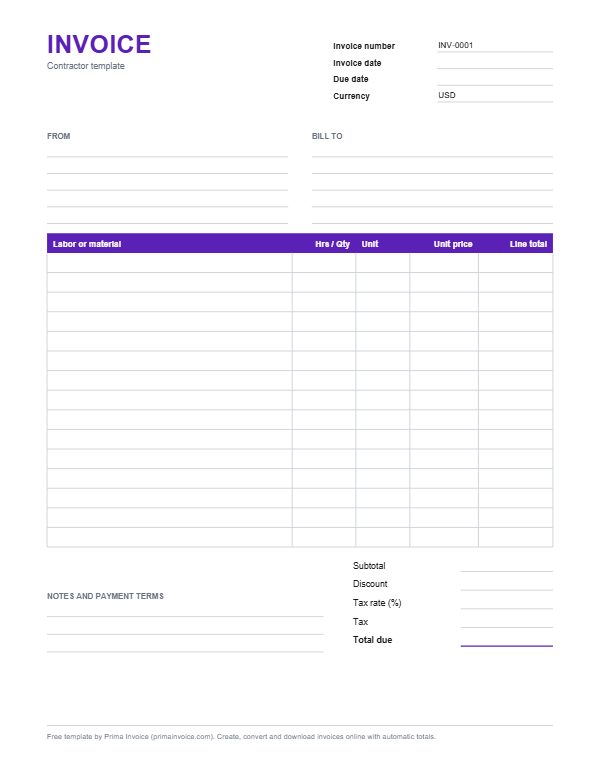
Example contractor invoice
These are typical lines for this kind of work. Edit, delete or add lines once the template is open.
| Labor or material | Hrs / Qty | Unit | Unit price | Line total |
|---|---|---|---|---|
| Call-out and diagnosis | 1 visitat $85.00 | visit | $85.00 | $85.00 |
| Labor: replace water heater | 3.5 hourat $95.00 | hour | $95.00 | $332.50 |
| 50 gallon gas water heater | 1 pieceat $899.00 | piece | $899.00 | $899.00 |
| Flex connectors and fittings | 1 setat $46.50 | set | $46.50 | $46.50 |
| Expansion tank, 2 gallon | 1 pieceat $54.00 | piece | $54.00 | $54.00 |
| Permit filing fee, passed through | 1 feeat $75.00 | fee | $75.00 | $75.00 |
| Haul away and dispose of old unit | 1 loadat $60.00 | load | $60.00 | $60.00 |
| Subtotal before tax | $1,552.00 | |||
Typical columns on a contractor invoice
| Column | What to put in it |
|---|---|
| Labor or material | Say what was done or supplied in plain words: "Replace kitchen faucet", "PEX pipe, 1/2 inch". Keep labor and parts on separate lines. |
| Hours or quantity | Labor hours (2.5 for two and a half hours) or the number of parts, metres, boxes or bags used. |
| Unit | hour, visit, piece, foot, metre, bag, load. Homeowners query bills far less when units are spelled out. |
| Unit price | Your hourly labor rate or the price per item. If your materials include a markup, use the marked-up price consistently. |
| Line total | Hours or quantity multiplied by unit price, calculated automatically online and in the Excel file. |
| Job address and date | Put the site address and the date or dates of work in the notes, especially when the billing address differs from where you worked. |
Why trades invoices split labor and materials
Customers judge a trade bill line by line. When the water heater, the fittings and the hours sit on separate rows, the homeowner can compare the unit price with what they saw at the store and the hours with how long your van was outside. A single lump sum, even a fair one, invites the question "what is this for?" and a phone call before anyone pays.
Separate lines also help you. If a customer disputes the labor, the parts are still clearly owed. If you need to show a supplier warranty claim later, the exact model and price is on record. And if your local tax rules treat materials and labor differently, the split is already there for you to apply the right rate to each.
Call-out fees, minimum charges and travel
Many trades charge a call-out, trip or diagnosis fee to cover driving to the property and finding the fault. Put it on its own line at the top so it is never mistaken for padding. If you waive it when the customer goes ahead with the repair, show the fee and then a matching discount rather than leaving it off silently; customers remember that they received something for free.
A minimum charge, such as one hour of labor for any visit, should match what you told the customer when they booked. Write it in your standard terms and on your website or booking confirmation so the invoice simply applies an agreed rule.
Long trips to rural jobs can be billed as travel time or mileage. Agree which one in advance and keep the unit consistent: "Travel, 40 miles" or "Travel time, 1 hour".
Materials, markups and pass-through costs
Contractors usually supply parts and charge for them. Some pass them through at cost and earn their margin on labor; others add a markup to cover sourcing, collection, storage and the risk of returns. Both are normal. What matters is that the price on the invoice is the price the customer agreed to, either in your quote or in your published rates.
Permit fees, skip or dumpster hire and inspection charges paid to a third party are often shown as pass-through items. Label them that way and keep the receipt in case the customer or an inspector asks for it.
If the customer bought some materials themselves, write a short note saying so. It explains why the materials section looks lighter than expected and protects you if a customer-supplied part later fails.
Deposits, progress payments and the final balance
For larger jobs, ask for a deposit before ordering materials. When you send the final invoice, record the deposit as a payment so the document clearly shows the full job value, the amount already received and the balance due. Prima Invoice prints the remaining balance on the PDF automatically once a payment is recorded.
Jobs that run over several weeks are easier to fund with stage payments: one when rough-in is complete, another after inspection, the last at handover. Each stage is its own invoice that names the stage. Big multi-month building projects with retainage and change orders have their own needs, covered in our construction invoice template.
Licence numbers, warranties and paperwork
In many places, licensed trades are expected to show a contractor licence or registration number on paperwork. Add yours to the business details or the notes field so it appears on every invoice. Requirements vary by state, province and country, so check with your licensing board.
State your workmanship warranty briefly, for example "Labor guaranteed for 12 months from the date of completion", and mention that manufacturer warranties apply to supplied parts. A clear warranty line reduces callbacks about what is and is not covered.
Photos of the finished work, the serial number of installed equipment and any inspection sign-off are worth attaching to the email that carries the invoice. They answer questions before anyone asks.
A worked example using the sample job
The sample lines describe a water heater replacement. A call-out and diagnosis visit is $85. Three and a half hours of labor at $95 come to $332.50. The heater itself is $899, the connectors and fittings $46.50 and the expansion tank $54. The permit filing fee of $75 is passed through, and hauling away the old tank is $60. The subtotal before any tax is $1,552.
These figures are examples to show the structure, not prices to copy. Rates for the same job differ widely between cities and countries, and your own costs decide what you charge.
Invoicing on site from your phone
The fastest way to get paid is to hand over the invoice before you leave. The online generator works in a phone browser, keeps your draft on the device, and lets you download a PDF to send by text message, email or WhatsApp straight from the driveway.
Add a payment link from your own Stripe or PayPal account and many customers will pay on the spot. The money goes directly to you; Prima Invoice never holds it. For customers who prefer a bank transfer or a cheque, put those details next to the total.
If you would rather fill in paper forms, print the blank PDF and keep a pad of them in the van. Write the invoice number on each one before you start, so you never issue the same number twice.
Keeping your trade records tidy
Every invoice should match a job in your diary and a set of supplier receipts. At the end of the week, mark which invoices are paid, chase the rest and file the PDFs by month. Tax authorities expect self-employed trades to keep records that show how income and costs were worked out, and an orderly invoice sequence makes that painless.
Avoiding the usual disputes with homeowners
Most arguments over trade bills trace back to three gaps: the scope was never written down, the price changed without warning, or the customer did not realise how long cleanup and testing take. Close each gap before the job, not on the invoice. A two-line quote by text message, sent and accepted, is enough to settle what was agreed.
When you discover hidden damage behind a wall or under a floor, stop, photograph it, explain the options and get a yes before continuing. Then the extra lines on your bill are a record of a decision the owner made, rather than a surprise.
Insurance and property-management jobs bring another layer: claim numbers, tenant names, unit numbers and sometimes a required format. Put every reference the payer gave you into the notes, because missing paperwork is the main reason those invoices sit unpaid for weeks.
Finally, be careful with wording. Vague phrases such as "miscellaneous supplies" or "sundries" irritate customers. Name the consumables, or fold them into your hourly rate and say so in your terms.
Tips for your contractor invoice
Quote first, then invoice the same lines
Send a quote with the same labor and parts lines, then convert it to the invoice once the job is done. Nothing gets retyped and the customer sees exactly what they approved.
Describe parts by size and model
"Ball valve, 3/4 inch, brass" is better than "valve". It matches the supplier receipt and helps with warranty claims later.
Show extras as separate lines
Extra work found on the day, like a corroded shut-off valve, belongs on its own line with a note that the customer approved it on site.
Put the due date in plain words
Write "Due on receipt" or an actual date. Homeowners rarely know what Net 15 means, but everyone understands a date.
Carry blank forms as a backup
Phone batteries die. A few printed blank PDFs in the glovebox mean you can still leave a proper invoice when the tech fails.
Snap before-and-after photos
Two pictures on your phone settle most questions about workmanship, mess or damage that existed before you arrived. Attach them to the email with the PDF.
Itemise disposal and skip hire
Old fixtures, rubble and packaging cost money to dump. A visible disposal line explains the charge and stops it looking like padding.
Frequently asked questions
Should materials and labor be on separate lines on a contractor invoice?
Yes, in almost every case. Separate lines let the customer check prices, protect the undisputed part if one line is questioned, and make it easy to apply different tax treatment if your local rules require it.
How do I show a call-out fee that I am waiving?
List the call-out fee at its normal price and add a discount for the same amount with a short note such as "Call-out waived, repair booked". The customer sees the value of what you gave them.
Can a contractor charge a markup on materials?
Generally yes, as long as the price matches what the customer agreed to in your quote or published rates. Some regulated contracts and insurance jobs limit markups, so check the terms of the job.
Where do I put my contractor licence number?
Add it to your business details so it appears near your name on every invoice, or put it in the notes. Whether it is required on invoices depends on your licensing board.
How should I invoice a job that took several visits?
Either invoice each visit as it happens, or list each visit date as its own labor line on one final invoice. Long projects with stage payments are clearer as one invoice per stage.
What if the homeowner wants to pay in cash?
Record the cash payment against the invoice and send a receipt made from the same data. The receipt maker converts the invoice in one click and marks it paid.
Is the contractor invoice template suitable for subcontractors billing a builder?
Yes. Use the builder's company as the client, add their job number or purchase order to the notes, and follow any invoicing schedule in your subcontract. For retainage and progress billing, see the construction invoice template.
How do I bill an insurance or property management repair?
Address the invoice to whoever pays, which may be the insurer, the landlord or the managing agent, and put the claim number, property address, unit and tenant name in the notes. Follow any format the payer specifies.
Do I charge sales tax on contractor labor?
It depends entirely on your state, province or country, and sometimes on the type of work. Some places tax materials but not installation labor, others tax both. Enter whatever rate applies to you; the generator never assumes one.
Sources
- GOV.UK: Invoices, what they must include
- GOV.UK: Invoicing and taking payment from customers
- IRS: Recordkeeping for small businesses
Sources checked 2026-10-25. Rules differ by country, so check with your local tax office or an adviser.
Related templates
Construction Invoice Template
Progress invoice for builders and construction companies, with stage, change order, materials and retainage lines.
Landscaping Invoice Template
Lawn care and landscaping invoice with mowing, cleanup, mulch, planting, irrigation and green waste lines.
Free Estimate Template
Cost forecast with labour, materials, allowances, assumptions and a may-change note, convertible into an invoice.
Fill it in online, download a PDF
The invoice generator opens with this template's lines. Add your prices, tax and logo, then download.