
Free Receipt Template
A receipt template is a ready-made document that confirms a customer has paid you. It shows your business details, the customer, a receipt number, the payment date and method, what was bought, the total, the amount paid and any balance remaining, often marked PAID. Download it free for Excel, Word or as a blank PDF, or open it in the receipt maker with typical lines already filled in and download a finished PDF.
Free, no account. Opens the receipt maker with these lines filled in.
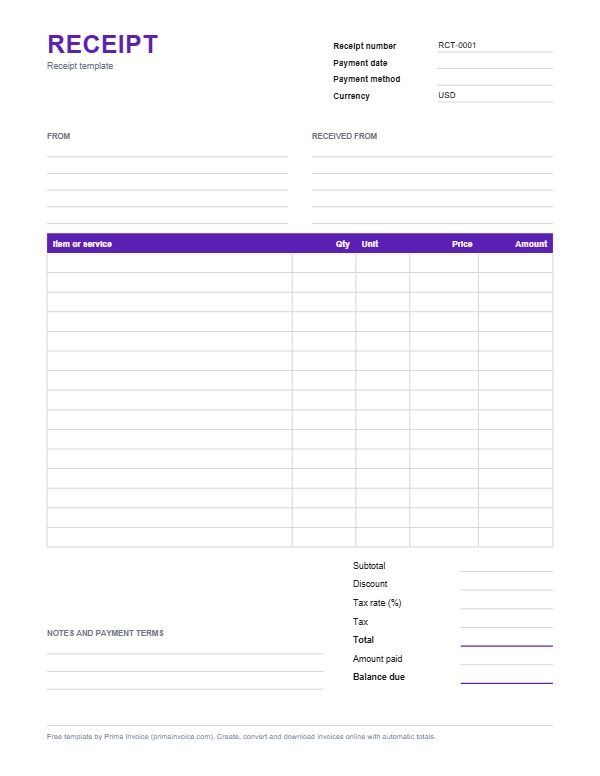
Example receipt
These are typical lines for this kind of work. Edit, delete or add lines once the template is open.
| Item or service | Qty | Unit | Price | Amount |
|---|---|---|---|---|
| Private yoga class, 60 minutes | 4 classat $45.00 | class | $45.00 | $180.00 |
| Yoga mat, natural rubber | 1 itemat $59.00 | item | $59.00 | $59.00 |
| Cork block | 2 itemat $14.00 | item | $14.00 | $28.00 |
| Workshop: breathing basics | 1 seatat $35.00 | seat | $35.00 | $35.00 |
| Studio drop-in pass | 3 passat $18.00 | pass | $18.00 | $54.00 |
| Gift card, redeemable at the studio | 1 cardat $50.00 | card | $50.00 | $50.00 |
| Subtotal before tax | $406.00 | |||
Typical columns on a receipt
| Column | What to put in it |
|---|---|
| Item or service | What the payment was for, named the same way as on the original invoice or price list. |
| Qty | How many units were bought or how many hours were paid for. |
| Price | The price per unit actually charged, after any agreed price change. |
| Amount | Quantity times price for each line, added up into the total. |
| Payment date and method | When the money arrived and how: cash, card, bank transfer, cheque, mobile wallet. The heart of any receipt. |
| Amount paid and balance | Shows whether the payment settled everything or was a part payment, and what remains due. |
Invoice or receipt: which one do you need?
They look alike but do opposite jobs. GOV.UK puts it plainly: an invoice is not the same as a receipt, which is an acknowledgement of payment. An invoice asks for money that is owed; a receipt confirms that money was received. A dictionary definition makes the same point from the buyer's side: a receipt shows the price of something you bought and proves you paid for it.
So the order is usually quote or estimate, then invoice, then receipt. Shops and many service providers skip the invoice and hand over a receipt at the till because payment happens on the spot. Freelancers and businesses that bill on credit send an invoice first and a receipt only when the customer asks for one or needs proof for their own records.
What a good receipt includes
Keep it complete enough that the customer could use it as evidence: your business name and contact details, the customer's name if known, a unique receipt number, the date of payment, a description of each item or service, the amounts, the total, the payment method and the amount received. If the payment relates to an earlier invoice, quote that invoice number. If you are registered for a sales tax such as VAT or GST, show the tax and your registration number where your local rules require it.
Mark the document clearly as a receipt and, when the full amount has been paid, add a PAID stamp or label. The receipt maker does this automatically.
Partial payments, deposits and balances
Not every payment clears the whole bill. When a customer pays a deposit or an instalment, the receipt should show the total owed, the amount received today and the remaining balance, so nobody is unsure what is still due. Number each part-payment receipt separately and reference the same invoice.
When the final instalment arrives, issue a last receipt showing a zero balance. Many customers keep that final one as their proof that the account is settled.
Why customers keep receipts
Customers file receipts for returns and warranties, for expense claims at work, for insurance, and for tax. The US Internal Revenue Service lists sales slips, paid bills, invoices, receipts, deposit slips and cancelled checks among the supporting documents businesses keep. A clear, legible receipt with an itemised description saves your customer trouble later and reflects well on you.
Businesses that pay you may also need a receipt to reconcile their books when they paid in cash or by a method that leaves no clear trail.
Payment methods worth naming precisely
"Card" is fine for most purposes, but more detail helps when payments are disputed: the last four digits of the card, the card network, the transaction or authorisation reference, or the bank transfer reference. For cheques, note the cheque number and bank. For mobile wallets and payment apps, record the transaction ID the app shows.
Never write a full card number, security code or online banking password on a receipt. The last four digits are plenty for identification.
Receipts for cash payments
Cash leaves no automatic record, so a receipt is the only evidence for both sides. Write the amount in figures and, for larger sums, also in words, as on a cheque. Sign it if you hand it over in person. Keep a copy, either a carbon duplicate from a receipt book or a photo, and record the cash in your books the same day. Tax authorities pay particular attention to cash businesses, and tidy receipts are the simplest way to show your takings were recorded properly.
A worked example with the sample lines
The sample shows a yoga studio receipt: four private classes at $45 ($180), a $59 mat, two cork blocks at $14 ($28), a $35 workshop seat, three drop-in passes at $18 ($54) and a $50 gift card. The total is $406. In the receipt maker the amount paid defaults to the total, so the balance shows zero and the document is marked PAID; change the amount paid for a part payment.
Some places treat gift cards differently for tax or record-keeping; if that applies to you, list them as a separate line, as the sample does. Prices are examples only.
Turning an invoice into a receipt in one click
If you created the original invoice with Prima Invoice, you do not need to retype anything. Open the invoice, choose convert to receipt, enter the payment date, method and amount, and download the PDF. Every line, tax and total stays exactly the same, and the receipt number follows its own RCT sequence so it never collides with invoice numbers.
With a Prima Invoice account you can also record payments against sent invoices and the status changes to Partially paid or Paid automatically.
Receipts are not for faking expenses
Receipt templates are for recording real payments you actually received. Creating receipts for purchases that did not happen, or imitating another company's branded receipts, can be fraud. Prima Invoice templates carry no third-party branding, and we ask everyone to use them only for genuine transactions.
Common kinds of receipt and what each adds
A rent receipt records the tenant, the property address, the rental period covered and how rent was paid; landlords often issue one monthly, and tenants use them as proof of residence or payment history. A sales receipt from a shop lists products, quantities and any discounts. A service receipt names the work and the date it was delivered. A deposit receipt confirms money held against a booking or a future job and should state the conditions for refund or forfeiture.
Tuition, therapy, physiotherapy and coaching receipts frequently end up in insurance claims or reimbursement requests, so include the practitioner's name and credentials, the session dates and any provider number the insurer expects. Donation acknowledgements for charities follow specific tax-authority wording in many countries; if you run a registered charity, follow your regulator's guidance rather than a general template.
Whatever the type, the essentials stay the same: who paid, who received, when, how much, for what, and by which method.
Refunds, returns and corrected receipts
When you refund some or all of a payment, record it with its own document rather than editing the original receipt. A refund receipt or credit note quotes the original receipt number, the items returned, the amount sent back, the method and the date. Customers returning goods appreciate it, and your accounts show both the sale and the reversal clearly, which is what an auditor wants to see.
If you spot a typo on a receipt you already issued, such as a misspelt customer name, issue a corrected copy marked as a replacement for receipt number so-and-so.
Paper, email or text: delivering the receipt
Many customers now prefer an emailed or texted PDF to a slip of paper. Digital receipts do not fade, cannot be lost in a pocket, and are searchable later. Printed thermal till slips, by contrast, tend to fade over time, especially when kept somewhere warm or sunny, which is a nuisance for anyone keeping them for warranty or expense claims. If you print receipts, consider offering a digital copy as well.
For bookkeeping, keep your own copies for as long as your tax authority requires records to be retained. Retention periods vary by country and by type of record, so confirm the period with your accountant.
Receipts for online orders and foreign currencies
Online sellers usually email a confirmation automatically, but customers paying by bank transfer, cheque or another manual method often ask for a proper receipt afterwards. Include the order number, shipping charges as a separate line, and the delivery address if it differs from the billing address. For marketplace platforms that issue their own documents, check whether they already send buyers a receipt on your behalf before duplicating one.
When you are paid in a currency other than your own, write the receipt in the currency the customer actually paid. If your bank converted it, note the converted amount in your own records rather than on the customer's copy. Prima Invoice supports every ISO 4217 currency, with the correct decimals: none for yen, two for dollars and euros, three for Bahraini dinar.
Receipt books versus generated receipts
Pre-printed duplicate books with sequential numbers remain popular at markets, fairs, school fundraisers and sports clubs because they need no battery and leave an automatic copy. Their weaknesses are handwriting, lost books and manual totals. Generated receipts solve those, and a phone browser is enough to create one at a stall. Many small traders use both: paper for quick cash sales, digital for anything a customer will claim on expenses.
Signatures, stamps and handwritten amounts
A signature is not essential on most receipts, yet for cash handed over in person, a signed note reassures both parties. Some businesses also use a rubber stamp with their trading name, especially in regions where company chops or seals are customary. For larger cash sums, writing the amount in words as well as figures, for example "Four hundred and six dollars only", prevents anyone adding a digit afterwards. Keep the wording consistent across your receipts so tampering would stand out.
Tips for your receipt
Quote the invoice number
When a receipt settles an invoice, reference its number. Both you and the customer can match them instantly.
Show the balance on part payments
Total, amount paid today and balance remaining on every instalment receipt avoids any confusion about what is owed.
Record the payment reference
Card last four digits, transfer reference or cheque number make disputes and refunds easy to trace.
Keep copies of cash receipts
A duplicate book or a phone photo is your only proof of cash income. Record it in your books the same day.
Use a separate number sequence
RCT-0001, RCT-0002 for receipts keeps them apart from INV invoice numbers and avoids duplicate references.
Offer a digital copy
An emailed PDF never fades or gets lost, and customers claiming expenses will thank you for it.
Write big cash amounts in words
Adding "Four hundred and six dollars only" beside the figure stops anyone inserting an extra digit later.
Separate shipping and handling
Postage, packaging and courier charges on their own line help customers claim them and help you reconcile carrier bills.
Reprint lost receipts as copies
When a customer loses a receipt, issue a duplicate clearly marked COPY with the original number and date, never a fresh number.
Frequently asked questions
What is the difference between an invoice and a receipt?
An invoice requests payment for goods or services; a receipt confirms that payment was received. GOV.UK describes a receipt as an acknowledgement of payment.
Do I have to give my customer a receipt?
It depends on where you are and the type of sale. Many businesses give one with every payment, and some tax systems require a receipt or tax invoice on request. Check your local rules.
How do I write a receipt for a partial payment?
Show the full amount owed, the amount received on this date and the balance remaining, and reference the related invoice. Issue a new receipt for each instalment.
Should a receipt include the payment method?
Yes. Name the method, such as cash, card, bank transfer or cheque, and add a reference like the card's last four digits or the transfer ID.
Can I make a receipt from an existing invoice?
Yes. In Prima Invoice, convert the invoice to a receipt and add the payment details; all lines, taxes and totals are kept exactly.
Is a receipt template free to use for my business?
Yes. The Word, Excel and PDF files and the online receipt maker are free, with no account required.
How do I issue a receipt for a refund?
Create a separate refund receipt or credit note that references the original receipt number, lists what was refunded, and shows the amount, method and date of the refund. Do not edit the original.
What should a rent receipt include?
The landlord and tenant names, the property address, the rental period covered, the amount received, the payment date and method, and any balance still owed.
Does a receipt need a signature?
Usually not, but signing a receipt for cash received in person adds reassurance. Writing large amounts in words as well as figures also discourages alteration.
Sources
- GOV.UK: Invoicing and taking payment from customers
- Cambridge Dictionary: receipt
- IRS: What kind of records should I keep
Sources checked 2026-10-25. Rules differ by country, so check with your local tax office or an adviser.
Related templates
Printable PDF Invoice Template
A blank, printable and fillable PDF invoice form, plus the option to generate a finished PDF online.
Free Quote Template
Fixed-price quotation with scope, line items, valid-until date and acceptance terms, convertible into an invoice.
Freelance Invoice Template
Hourly and project-based invoice for freelancers, with typical lines such as discovery calls, drafts, revisions and rush fees.
Fill it in online, download a PDF
The receipt maker opens with this template's lines. Add your prices, tax and logo, then download.