
Recipient Created Tax Invoice (RCTI): ATO Rules Explained
Contents
- What is a recipient created tax invoice?
- When you can issue an RCTI
- What a valid RCTI must show
- RCTI deadlines and record keeping
- RCTI vs standard tax invoice
- Recipient created invoice when the supplier is not registered for GST
- Recipient created tax invoice template
- Worked example: checking RCTI figures with Prima Invoice
- What changed in the RCTI rules
- Common RCTI mistakes to avoid
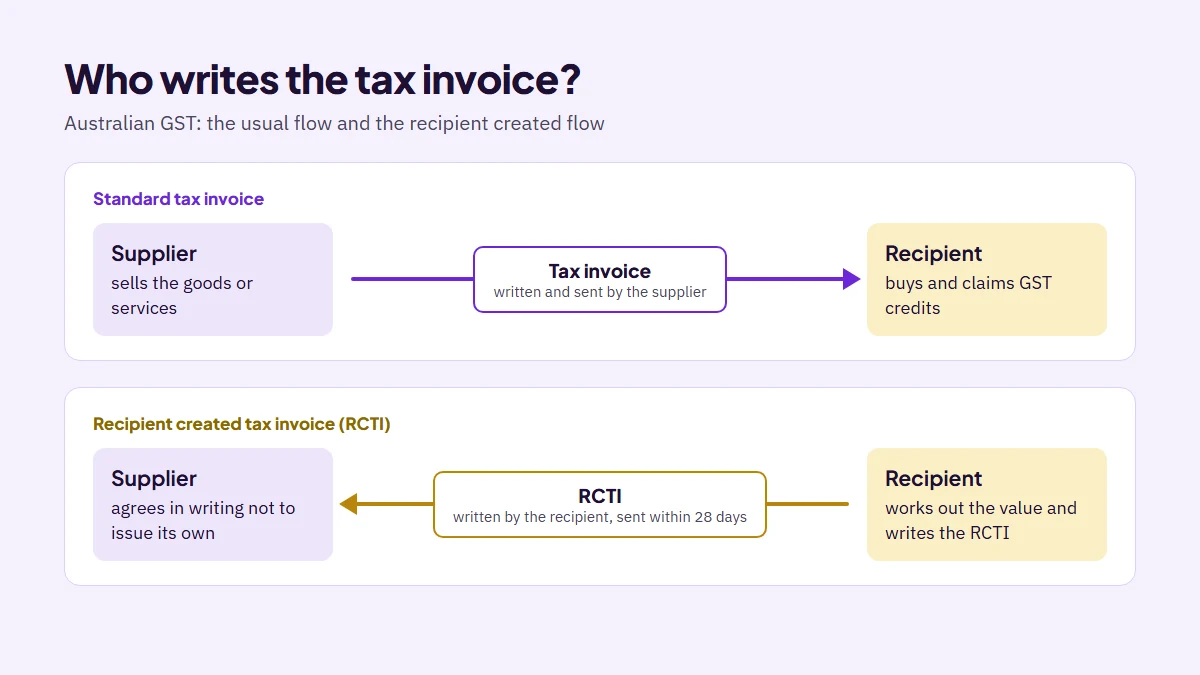
A recipient created tax invoice (RCTI) is an Australian GST tax invoice that the buyer writes instead of the seller. The Australian Taxation Office (ATO) allows it only in special cases: both businesses are registered for GST, they have agreed in writing that the buyer will issue the invoice, that agreement is current, and the type of supply is covered by the Commissioner's determination.
If you sell to a large business, a government body or a buyer who sets the price after delivery, you may never write your own invoice for that work. This guide explains when an RCTI is allowed, what it must show, the deadlines that apply, and how to check the numbers on one before you accept it.
What is a recipient created tax invoice?
In a normal sale the supplier issues the tax invoice and the buyer uses it to claim GST credits. An RCTI turns that around. The ATO's tax invoice guidance puts it simply: in most cases tax invoices are issued by a supplier, but in special cases the purchaser or recipient of the goods or services may issue a tax invoice for its purchases.
The word "recipient" is the key. The recipient is the business that receives the goods or services, which is usually the one paying. The supplier still makes the sale and still owes the GST on it. Only the job of writing the document moves to the other side. If you want a refresher on the basics first, see what an invoice is and what it must include.
Why would anyone want that? In practice it suits buyers who already hold the data that decides the price. A freight company knows how many runs a subcontractor drove. A buyer of graded produce or recycled material only knows the value after weighing or testing. Letting that buyer write the invoice removes a round trip where the supplier waits for figures, then sends an invoice that repeats them.
When you can issue an RCTI
The ATO lists four conditions, and all of them must be true when the RCTI is issued:
- You and the supplier are both registered for GST at the time the RCTI is issued.
- You and the supplier agree in writing that you may issue an RCTI and that they will not issue a tax invoice.
- The agreement is current and effective when you issue the RCTI.
- The Commissioner has determined that the type of goods or services can be invoiced using an RCTI.
That last condition points to the Recipient Created Tax Invoice Determination 2023. It names who may issue one. A government related entity or a large business entity may issue an RCTI for a taxable supply it receives. Any other GST-registered business may issue one only when it determines the value of the supply it acquires. In every case both parties must be registered for GST when the RCTI is issued.
| Who is the recipient? | May it issue an RCTI under the 2023 Determination? |
|---|---|
| Government related entity | Yes, for a taxable supply it receives |
| Large business entity | Yes, for a taxable supply it receives |
| Any other GST-registered business | Only when it determines the value of the supply it acquires |
| Either party not registered for GST | No |
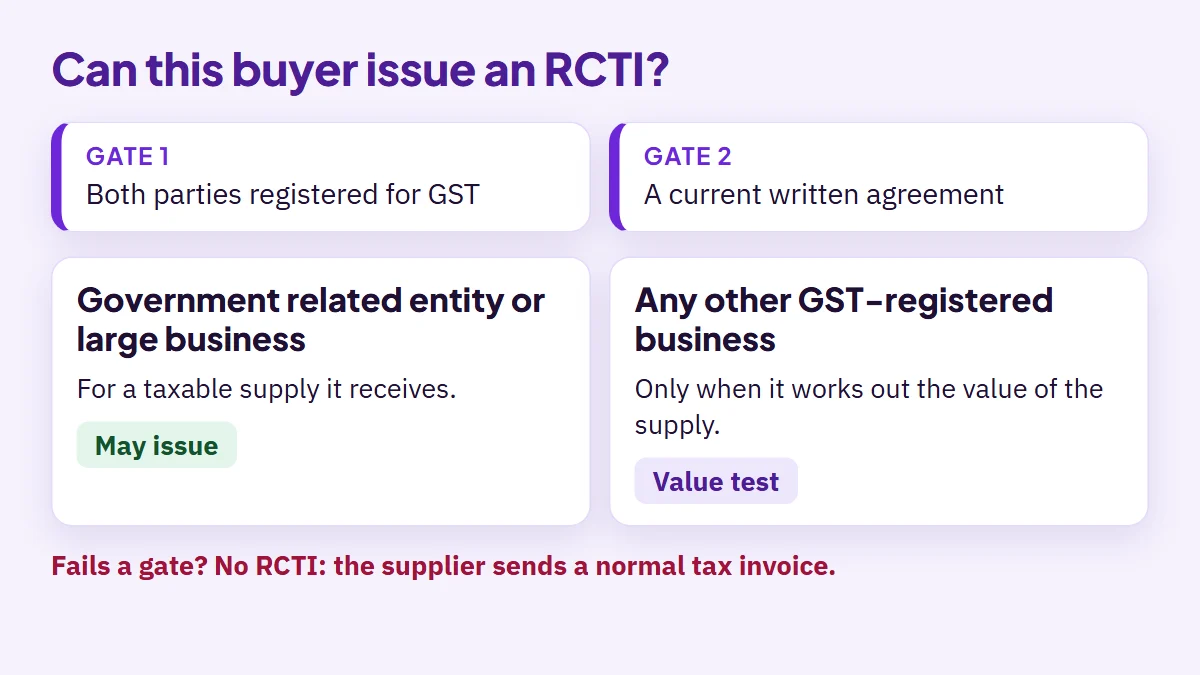
That value test is the one most small businesses meet. If you are a smaller buyer and the supplier sets the price, an RCTI is usually not available to you. The supplier simply sends a normal tax invoice.
Our view: if you are the supplier, read the RCTI agreement as carefully as a price list. It decides who writes your invoices, and you give up the right to issue your own for those supplies.
What a valid RCTI must show
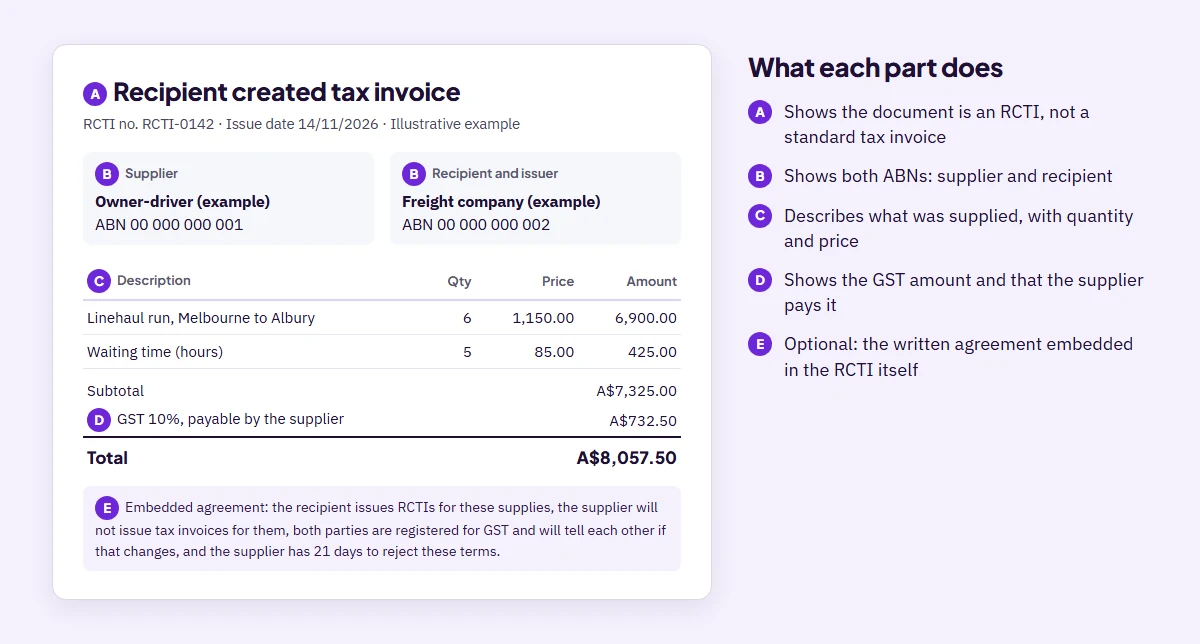
An RCTI has to meet the normal tax invoice rules and then a few more. According to the ATO, it must contain enough information to clearly work out the tax invoice requirements and show that the document is intended to be a recipient created tax invoice, not a standard tax invoice. On top of that it needs:
- Both ABNs. The ATO says it must show the supplier's and the purchaser's Australian business number (ABN).
- Who pays the GST. If GST is payable, the RCTI must show that it is payable by the supplier.
- The usual tax invoice details. For sales under $1,000 that means the seller's identity and ABN, the issue date, a brief description of the items with quantity and price, the GST amount and how far each sale is taxable. Sales of $1,000 or more also need the buyer's identity or ABN.
Our tip is to put "Recipient created tax invoice" as the document title, not in small print. The title is the first thing a supplier, a bookkeeper or an auditor reads, and it removes any doubt about which kind of tax invoice it is.
Can the agreement sit inside the RCTI?
Yes. Under the 2023 Determination the written agreement can be a separate document or it can be embedded in the RCTI itself. An embedded agreement must declare that it applies to the supplies on the RCTI, that the recipient will issue RCTIs and the supplier will not issue tax invoices for them, that both parties are registered for GST and will tell the other if that stops, that the supplier will say within 21 days if it does not accept the agreement, and that accepting the RCTI means accepting its terms.
A separate agreement has its own checklist in the Determination. It must name the supplies it covers, be current when each RCTI is issued, contain both parties' acknowledgment that they are registered for GST, and include conditions that each side will notify the other if it stops being registered.
RCTI deadlines and record keeping
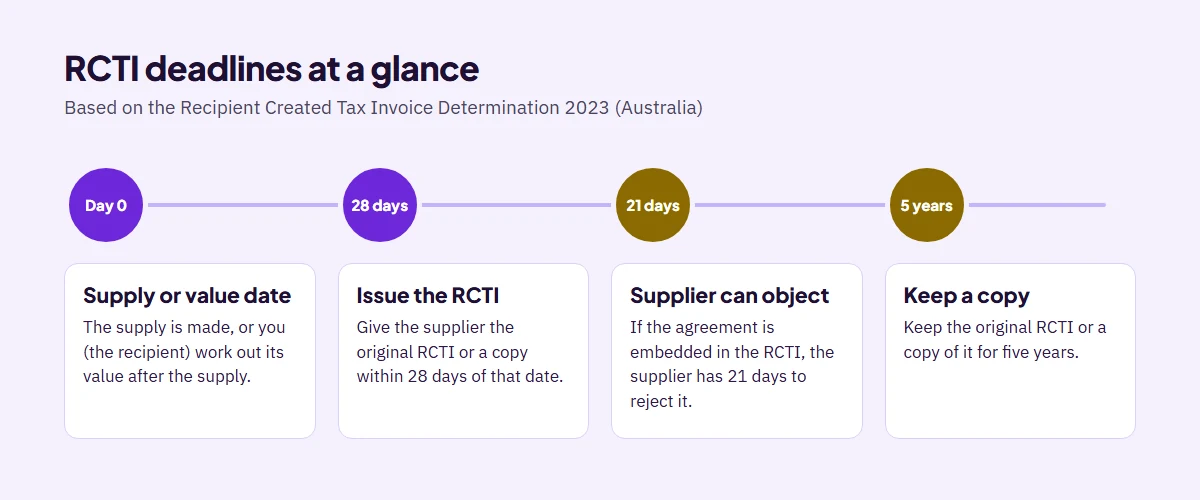
The clock starts on one of two dates. You must give the supplier the original RCTI or a copy within 28 days of the date of the sale, or within 28 days of the date you determine the value, when you work out the value after the supply.
After that, the Determination requires the recipient to keep the original RCTI or a copy for five years. If the agreement is embedded in the RCTI, the supplier has 21 days from issue to say it does not accept it. And once either party stops meeting the requirements, for example by cancelling its GST registration, the recipient must stop issuing RCTIs.
Digital delivery is fine. The ATO says a tax invoice does not need to be on paper and can be emailed as a PDF, as long as the document contains all the required information. A PDF tax invoice is still not a structured e-invoice; our e-invoicing guide explains Peppol, which Australia also uses.
RCTI vs standard tax invoice
The two documents hold almost the same data. The differences are about who writes it, what extra it must say and what has to exist before it can be issued.
| Point | Standard tax invoice | RCTI |
|---|---|---|
| Who issues it | Supplier | Recipient (the buyer) |
| Written agreement needed | No | Yes, separate or embedded |
| GST registration | Registered supplier issues it for taxable sales | Both parties registered when issued |
| ABNs shown | Seller's ABN; buyer's identity or ABN from $1,000 | Both supplier's and purchaser's ABN |
| GST wording | GST amount, or "Total price includes GST" | Also states GST is payable by the supplier |
| Deadline | Within 28 days of a customer's request | Within 28 days of the sale or value date |
The standard deadline comes from the ATO tax invoice page too: if a customer asks for a tax invoice you must provide one within 28 days, unless the sale is $82.50 including GST or less.
Recipient created invoice when the supplier is not registered for GST
This is a common question, and the answer is short: an RCTI is not available. Both parties must be registered for GST when the RCTI is issued, and the ATO says that if a supplier is no longer registered for GST, you cannot issue RCTIs to that supplier.
The ATO expects recipients to check a supplier's GST registration before the first RCTI and to recheck it from time to time on ongoing arrangements. The free ABN Lookup shows whether an ABN is active and its GST status. If you relied on a document that turns out not to be a valid RCTI and claimed GST credits on it, the ATO says you should make a voluntary disclosure.
For an unregistered supplier, the normal arrangement applies instead: the supplier invoices you. A supplier below the registration threshold is in exactly this position. The ATO's GST basics say you must register once your GST turnover reaches $75,000 ($150,000 for non-profit organisations), so a supplier crossing that line is a common trigger for setting up an RCTI agreement for the first time.
Recipient created tax invoice template
The ATO publishes a free Recipient-created tax invoices form (NAT 73657). The ATO describes it as something you can use as a template for creating RCTIs, or as a reference for the information you need to create your own.
People also search for an RCTI template in Excel. We do not publish one (our Excel invoice template is for standard invoices only), and we would rather say so than offer a spreadsheet that looks official. If you build your own, use the ATO form as the checklist: the RCTI title, both ABNs, the line items, the GST amount with "payable by the supplier", and either an embedded agreement or a reference to the separate one.
If you issue RCTIs regularly, accounting or payables software that already holds the quantities and prices is usually the better place to produce them. A template (our invoice templates cover ordinary invoices) suits low-volume arrangements, or checking that your software output has everything it needs.
Worked example: checking RCTI figures with Prima Invoice
Take an illustrative freight subcontract. An owner-driver (the supplier) drives six linehaul runs from Melbourne to Albury at $1,150.00 each and logs five hours of waiting time at $85.00 an hour. The freight company (the recipient) works out the value from its run sheets and issues the RCTI shown earlier in this guide.
Before accepting it, the owner-driver can check the arithmetic in our free invoice generator, which works in the browser without an account:
- Set the currency to AUD.
- Add two line items: "Linehaul run, Melbourne to Albury", quantity 6 at 1,150.00, and "Waiting time (hours)", quantity 5 at 85.00.
- Add one document tax, label it GST and type the rate 10. Prima Invoice never fills in tax rates for you; the label and rate are always yours.
We ran these exact figures through the Prima Invoice calculation engine. It returns line amounts of $6,900.00 and $425.00, a subtotal of $7,325.00, GST of $732.50 and a total of $8,057.50. That matches the RCTI. On an ongoing arrangement, a monthly statement of account from the recipient makes these checks faster. If your totals differ, raise it with the recipient straight away, before the figures flow into either business's GST reporting.
Be clear about the limits. Our generator produces a standard invoice (titled Invoice, with your details and a Bill to section), not an RCTI. It does not add the RCTI wording, the agreement or the "GST payable by the supplier" statement, and it does not check whether an RCTI is allowed. Use it to verify the numbers, or to issue your own invoice when no RCTI agreement covers the work.
If an RCTI arrangement ends and you go back to invoicing the client yourself, the contractor invoice template is a good starting layout, payment reminders in Prima Invoice Pro can follow up for you, and you can send a matching receipt once they pay (see our guide to a receipt of payment).
What changed in the RCTI rules
Older guides often cite GST ruling GSTR 2000/10. That ruling has been withdrawn with effect from 29 July 2026. The ATO's withdrawal notice says it continues to apply to RCTIs issued on or before 14 June 2023 but not to RCTIs issued on or after 15 June 2023, and that it will be replaced by draft ruling GSTR 2026/D2, which reflects the 2023 Determination.
The 2023 Determination also repealed a long list of industry-specific determinations, including ones for road transport operators, recyclers, quarry operators, agricultural products and food and grocery manufacturers and retailers. If your agreement still quotes one of those old instruments, it is worth having your accountant review it against the current rules.
Common RCTI mistakes to avoid
- Issuing to an unregistered supplier. Check the supplier's GST status in ABN Lookup before the first RCTI and periodically after that.
- Letting the agreement lapse. The agreement must be current when each RCTI is issued, not only when it was signed.
- Leaving out the RCTI wording. Without it, the document reads as a normal tax invoice that the buyer had no right to issue.
- Missing the 28-day window. Count from the sale date, or from the date you set the value.
- Supplier double invoicing. Under an RCTI agreement the supplier agrees not to issue its own tax invoices for the same supplies.
RCTIs are an Australian GST rule. Other countries have their own self-billing rules, so check local requirements before you copy this process elsewhere, and speak to a registered tax agent if you are unsure whether your arrangement qualifies.
Frequently asked questions
What is an RCTI invoice?
An RCTI is a recipient created tax invoice: an Australian GST tax invoice written by the buyer (the recipient) instead of the supplier. It is allowed only when both parties are registered for GST, have a current written agreement, and the supply is covered by the ATO determination.
Who can issue a recipient created tax invoice?
Under the Recipient Created Tax Invoice Determination 2023, government related entities and large business entities can issue RCTIs for taxable supplies they receive. Other GST-registered businesses can issue one only when they determine the value of the supply. Both parties must be registered for GST when the RCTI is issued.
Can I issue a recipient created invoice if the supplier is not registered for GST?
No. Both parties must be registered for GST when the RCTI is issued, and the ATO says you cannot issue RCTIs to a supplier that is no longer registered. Check the supplier's GST status in ABN Lookup first. If the supplier is not registered, they invoice you in the normal way.
How long do I have to issue an RCTI?
You must give the supplier the original RCTI or a copy within 28 days of the date of the sale, or within 28 days of the date you determine the value if you work it out after the supply. Keep the original or a copy for five years.
Is there an official recipient created tax invoice template?
Yes. The ATO publishes a free Recipient-created tax invoices form (NAT 73657) that you can use as a template or as a checklist of the information your own RCTI needs. The ATO does not provide an Excel version.
Can Prima Invoice create an RCTI?
No. The Prima Invoice generator makes standard invoices, quotes, estimates and receipts. You can use it to check the line items, GST and total on an RCTI you receive, or to invoice a client yourself when no RCTI agreement covers the work.
Does an RCTI have to be on paper?
No. The ATO says a tax invoice does not need to be on paper and can be emailed as a PDF, as long as it contains all the required information. The supplier must still receive the original or a copy within 28 days.
Is GSTR 2000/10 still the current RCTI ruling?
No. The ATO withdrew GSTR 2000/10 with effect from 29 July 2026. Its withdrawal notice says the ruling still applies to RCTIs issued on or before 14 June 2023, not to those issued from 15 June 2023, and that it will be replaced by draft ruling GSTR 2026/D2, which reflects the 2023 Determination.
Sources
- Australian Taxation Office, Tax invoices (including recipient-created tax invoices)
- Australian Taxation Office, A New Tax System (Goods and Services Tax): Recipient Created Tax Invoice Determination 2023 (LI 2023/20)
- Australian Taxation Office, Recipient-created tax invoices form (NAT 73657)
- Australian Taxation Office, GSTR 2000/10W withdrawal notice: recipient created tax invoices
- Australian Taxation Office, How GST works
- Australian Business Register, ABN Lookup